




Heat Rules Are Coming. Your Duty Is Already Here.
Every summer, the same question comes up on site. How hot does it have to be before we stop?
The honest answer is that there is no number. Australian WHS law does not set a stop-work temperature. But that has never meant heat is optional to manage, and this summer the national conversation about heat at work has changed.
What Changed This Month
On 5 November 2026, Safe Work Australia announced it will develop a national strategy on the work health and safety impacts of climate change. It came out of the Best Practice Review of the model WHS laws, which identified rising temperatures and more frequent heatwaves as the most immediate WHS risks from a changing climate.
The review’s Recommendation 20 goes further. It asks for new model WHS Regulations on extreme heat, air quality and vector-borne diseases, and for monitoring how existing laws are applied to extreme weather so any gaps can be fixed.
Other jurisdictions are already moving. The ACT introduced a Code of Practice on managing the risks of extreme temperatures in November 2025, and in April 2026 the NSW Net Zero Commission recommended mandatory heat stress prevention plans and safe heat thresholds.
None of that is law in Queensland yet. No timetable has been published, and nothing changes in the law this summer. But heat is already a hazard you must manage under the laws you have now.
Your Duty Already Applies
In Queensland, the primary duty in section 19 of the Work Health and Safety Act 2011 requires a person conducting a business or undertaking to ensure, so far as is reasonably practicable, the health and safety of workers. Heat sits inside that duty like any other hazard.
The Work Health and Safety Regulation 2011 is more specific. Section 40(f) requires a PCBU to ensure, so far as is reasonably practicable, that “workers carrying out work in extremes of heat or cold are able to carry out work without risk to health and safety”. Section 41 requires adequate facilities, including drinking water.
The Managing the work environment and facilities Code of Practice 2021 gives practical guidance on meeting those duties.
So if your heat plan is “we’ll see how hot it gets”, that is a gap now, not later.
Why a Temperature Alone Doesn’t Work
Workplace Health and Safety Queensland is clear that there is no workplace exposure standard for heat stress, and that setting a safe or unsafe limit based on air temperature alone is not appropriate.
Heat stress depends on three groups of factors:
- The environment: air temperature, humidity, radiant heat from sun, plant and hot surfaces, and air movement
- The work: how hard, how long, what time of day, and what clothing and PPE the work needs
- The person: acclimatisation, hydration, fitness, age, fatigue, health and some medications
That is why a 31 degree day in humid Mackay can be harder on a crew than a 36 degree day somewhere dry. It is also why two workers on the same job can react very differently.
The Highest-Risk Days Are Not Always the Hottest
This week, Resources Safety and Health Queensland asked resources operators to review their heat controls after a Queensland worker was hospitalised with severe cramping two days into a shift in hot weather. Dehydration was identified as a possible cause.
The regulator’s message was practical. Do not assume workers are acclimatised just because they have started their hitch. Workers returning from extended breaks, or who have not recently worked in similar conditions, should be introduced to hot work gradually, with extra rest breaks and cooler recovery areas.
That matters beyond mining. Think about new starters, labour hire workers, and everyone coming back after the Christmas shutdown into January heat. The first few days are when your system needs to work hardest.

What This Means For You
You do not need to wait for a national regulation to have a heat plan that works. Start with these checks:
- Assess the work, not just the weather. Use the WHSQ Heat stress (basic) calculator for your hot jobs. If it shows an unacceptable risk, get a technical assessment from a competent person such as an occupational hygienist.
- Set your own trigger points. Decide in advance what changes on hot days and very hot days, and who makes the call. Write it down and tell your workers.
- Change the work first. Start earlier, move heavy tasks to cooler parts of the day, use mechanical aids, rotate tasks and provide shade close to the work.
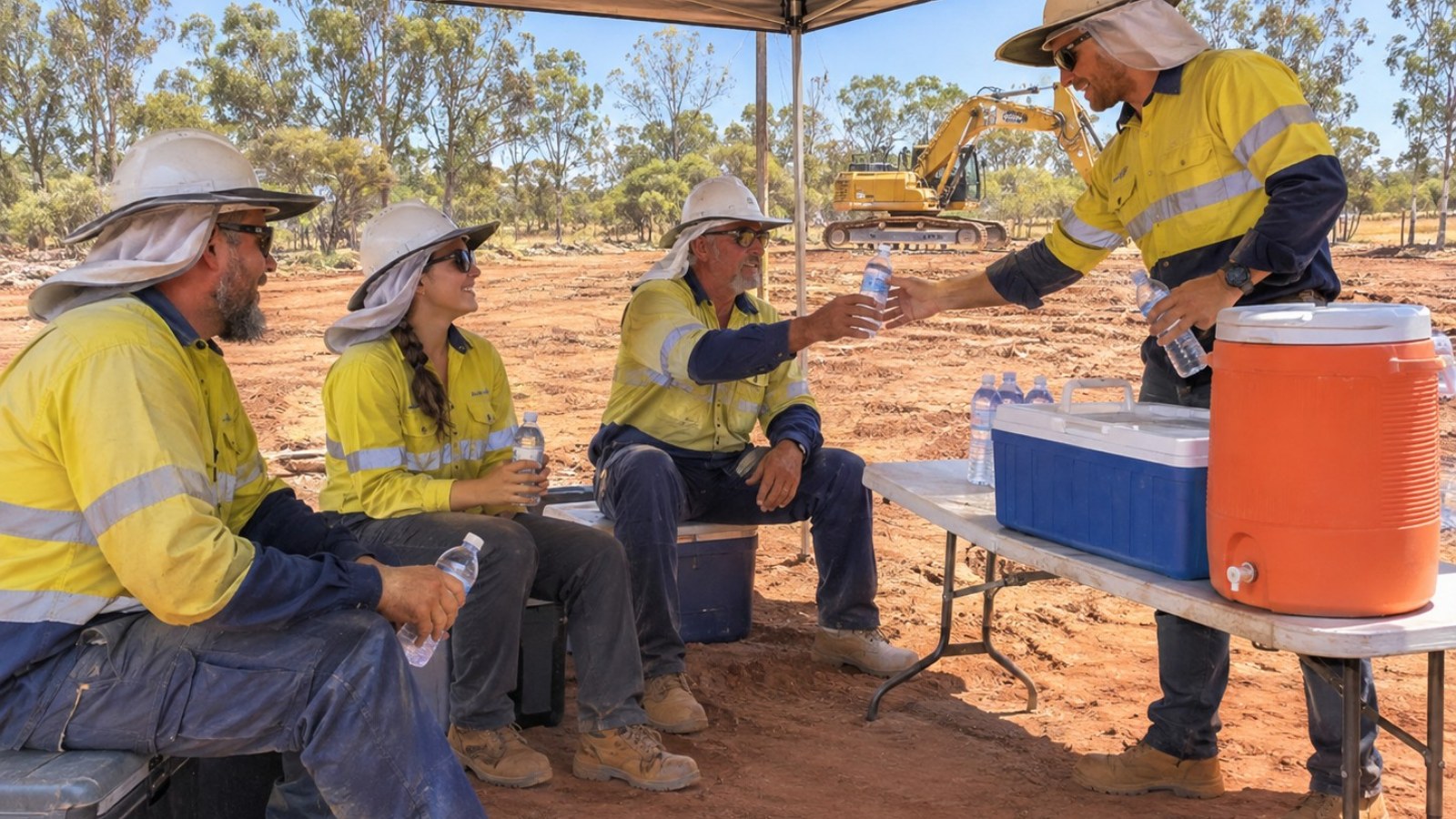
- Make water easy. Cool drinking water close to the work area, with workers encouraged to drink small amounts often rather than waiting until they are thirsty.
- Plan acclimatisation. Build in lighter workloads and extra breaks for new and returning workers.
- Supervise for symptoms. Cramps, dizziness, nausea, headache and unusual fatigue are early warning signs. Buddy checks help, especially for anyone working alone.
- Check your emergency response. Heat stroke is a medical emergency. Call 000 and start cooling immediately. Make sure your first aid and emergency plans cover it, and that people have practised it.
If you have read our articles on emergency plans that need practice and lone worker response systems, the same principle applies here. A plan only protects people when it works on the day.
The Real Lesson
Last week we looked at how the national WHS law review shows the direction of travel. Heat is the clearest example. New rules may come, but the duty is already here, and summer starts on 1 December.
The businesses that will find any new heat rules easy are the ones already managing heat through how work is planned and run, not through a poster in the crib room.
Book a Free Consult with Synergy Safety Solutions for a practical check of your heat controls before summer peaks.