




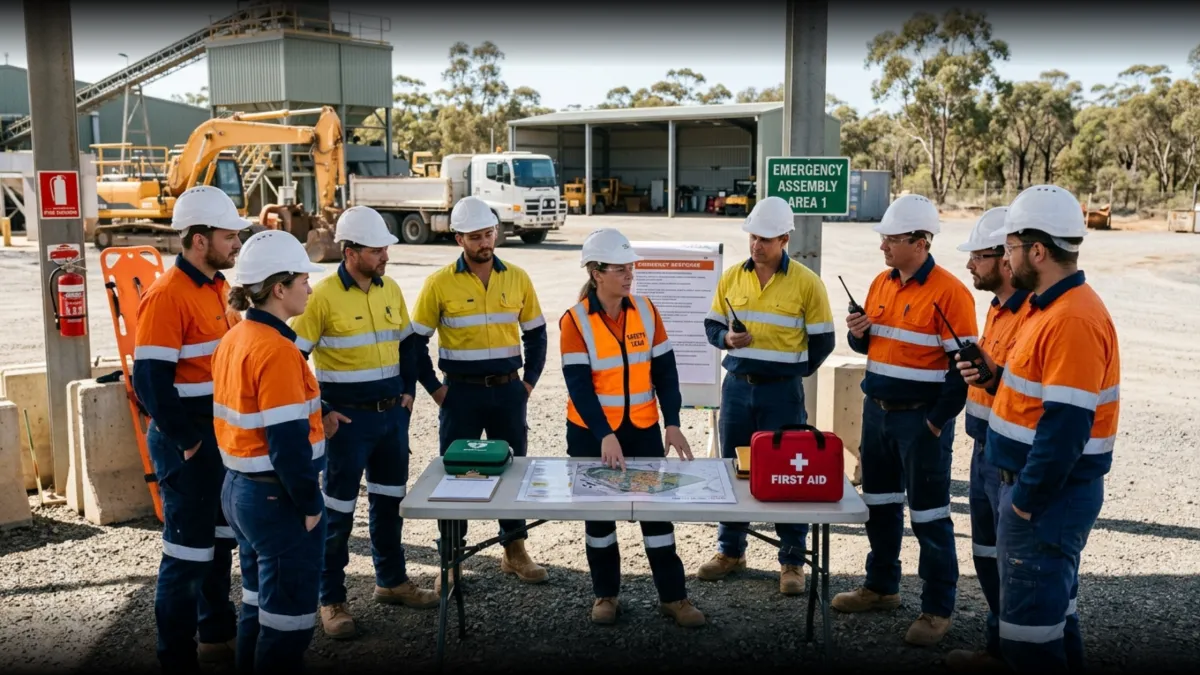
Emergency Plans Need Practice, Not Just Paperwork
Most workplaces have an emergency plan.
It may sit in an induction pack, on a noticeboard, in a folder, or inside the WHS management system.
It may list evacuation points, emergency contacts, fire wardens, first aiders, response steps, and reporting lines.
That matters.
But an emergency plan is not the same as emergency readiness.
Readiness is what happens when people need to act quickly, communicate clearly, make decisions under pressure, and adapt when the situation does not follow the script.
That is where many workplaces can find the gap.
The plan exists.
The drill happens once a year.
Everyone walks to the assembly point.
The box gets ticked.
But has the team really practised what they would do if someone was injured, access was blocked, a worker was missing, communication failed, weather changed, or the person expected to lead the response was not available?
That is the practical question.
A recent NSW SES State Disaster Rescue Challenge showed why realistic practice matters. More than 70 NSW SES members took part in eight high-pressure emergency scenarios based on a mass-casualty flash flooding event.
The scenarios tested more than technical rescue skill. They also tested teamwork, leadership, communication, and problem-solving under pressure.
That is the part workplaces should pay attention to.
You may not need a large-scale emergency simulation.
But if your emergency drills are always predictable, comfortable, and easy to complete, they may not be building the capability your team will need when something goes wrong.
A Plan Is Only the Starting Point
Emergency plans are important.
They help set roles, responsibilities, contacts, evacuation arrangements, first aid processes, emergency equipment, and escalation steps.
Without a plan, people are more likely to hesitate or improvise when they should be acting.
But the plan is only the starting point.
The real test is whether people can use it.
Do workers know what to do if the normal exit cannot be used?
Does the supervisor know who has been accounted for?
Do people know how to raise the alarm if mobile reception fails?
Do first aiders know where equipment is and how to access it quickly?
Does the team know what to do if the emergency involves a contractor, visitor, or member of the public?
Does anyone know what happens after the first call for help?
These are practical questions.
They are also the kinds of questions that do not always get tested in a basic drill.
Predictable Drills Can Create False Confidence
A predictable drill can still be useful.
It helps people learn evacuation routes, assembly points, and basic expectations.
But if the same drill is repeated in the same way every time, people can become good at completing the drill rather than responding to an emergency.
They know the alarm is coming.
They know the route.
They know the assembly area.
They know no one is actually missing, injured, trapped, confused, or panicked.
That kind of drill may show that people can follow a familiar process.
It does not necessarily show that the workplace can respond when the situation is unclear.
Real emergencies are rarely tidy.
People may receive incomplete information.
Access may be blocked.
Someone may make the wrong assumption.
A worker may be isolated.
A contractor may not understand the site.
A visitor may not know where to go.
Equipment may not be where people thought it was.
The person with the most experience may not be there.
That does not mean drills need to be dramatic or frightening.
It means they need to be realistic enough to reveal whether the system works.
Pressure Changes How People Respond
Under pressure, people do not always respond the way they think they will.
Some people freeze.
Some people act too quickly.
Some people wait for instructions.
Some people assume someone else has taken control.
Some people focus on one task and miss the bigger situation.
This is normal human behaviour, especially when information is limited and time matters.
That is why practice is so important.
A good emergency exercise gives people a safe way to experience pressure before a real incident occurs.
It helps them practise communication, decision-making, escalation, role clarity, and situational awareness.
It also helps leaders see where the system is unclear.
Who naturally takes control?
Who needs more support?
Where does communication slow down?
What information is missing?
What does the team assume will happen?
What actually happens?
Those lessons are difficult to get from paperwork alone.
Emergency Readiness Is Not Just for Emergency Services
The NSW SES example comes from emergency services, where rescue capability is part of the work.
Most businesses do not need training at that scale.
But the principle still applies.
Workplaces across construction, civil work, manufacturing, logistics, agriculture, mining, offices, events, schools, hospitality, health care, community services, and small business all need people who can respond when something goes wrong.
The emergency might be:
a fall from height
a medical episode
a fire
a chemical spill
a vehicle incident
a plant entrapment
a severe weather event
a power outage
a missing worker
a violent or aggressive person
a confined space incident
a site evacuation
Different workplace.
Different emergency.
Same question.
Has the team practised enough to respond clearly, calmly, and effectively?
The Drill Should Match the Real Risk
A good emergency drill should reflect the risks that actually exist in the workplace.
A civil construction site may need to test severe weather, mobile plant interaction, trench access, or worker injury in a changing site layout.
A warehouse may need to test fire response, forklift incidents, pedestrian movement, blocked exits, or evacuation across shift changes.
A farm or remote worksite may need to test delayed emergency response, poor phone reception, vehicle incidents, heat stress, or a worker who does not check in.
A workshop may need to test equipment isolation, burns, crush injuries, chemical exposure, or first aid response.
An office may need to test evacuation, medical emergencies, aggressive visitors, after-hours work, or people with access needs.
The point is not to make training complicated.
The point is to make it relevant.
If the drill does not reflect the real risks in the business, it may only prove that people can follow a simple routine.
Rescue Plans Need to Work in Practice
Some emergency arrangements look good until you ask what would actually happen.
This is especially true where rescue may be difficult, delayed, or dependent on specific equipment and trained people.
Confined space work is a clear example. A rescue plan written in a folder does not help if the people on site do not understand the plan, cannot access the equipment, or have not practised the steps.
We explored that issue in Confined Space Safety Needs More Than a Permit, where the practical test is not whether the rescue plan exists, but whether it would work when conditions change.
The same thinking applies to other workplace emergencies.
If a worker falls, who calls emergency services?
Who controls the area?
Who provides first aid?
Who guides emergency responders to the right location?
Who manages other workers, contractors, visitors, or the public?
Who communicates with management and family contacts?
Who records what happened?
If those answers are unclear, the emergency plan is not ready yet.
Response Systems Need a Next Step
Raising the alarm is only one part of emergency response.
Someone still needs to act on it.
This matters for lone workers, remote workers, after-hours work, field staff, mobile workers, and anyone working away from immediate help.
A check-in process is only useful if someone knows what to do when the check-in is missed.
A duress alarm is only useful if there is a clear response behind it.
A radio call is only useful if people know who is listening, who responds, and what happens next.
We discussed this in Lone Worker Safety Is Only as Good as the Response Behind It, and the same principle sits inside emergency preparedness more broadly.
An emergency system should not stop at notification.
It needs escalation, action, and follow-through.
Debriefing Is Where the Real Learning Happens
A drill without a debrief is a missed opportunity.
It may still meet a basic requirement, but it does not build much learning.
A useful debrief does not need to be long or formal.
It should answer practical questions:
What worked?
What was unclear?
Where did communication slow down?
Did everyone understand their role?
Were emergency contacts current?
Was equipment accessible?
Did the assembly process work?
Were contractors or visitors considered?
Did anyone hesitate because they were unsure?
What would we change before next time?
The debrief should not be about blaming people.
It should be about improving the system.
If the drill revealed confusion, that is useful information.
If the team found a gap, that is a good thing.
Better to find it during practice than during a real emergency.
What This Means For You
If your workplace has an emergency plan, the next question is not: “Do we have the document?”
The better question is: “Have our people practised using it in conditions that feel close enough to reality?”
That does not mean creating fear or chaos.
It means adding enough realism to test whether the plan works.
Change one detail.
Block one exit.
Remove one key person from the scenario.
Test a missed check-in.
Add a visitor.
Add a weather issue.
Add a communication delay.
Ask the team what they would do if the first option was no longer available.
These small changes can reveal whether people understand the plan or are simply following a familiar routine.
Practical Ways to Improve Emergency Readiness
If your emergency drills have become too predictable, start with small improvements.
Match drill scenarios to the actual risks in your workplace
Change one variable each time, such as access, weather, injury, communication, or missing people
Include contractors, visitors, remote workers, or after-hours workers where relevant
Test how the alarm is raised and what happens after it is raised
Rotate leadership roles so more than one person knows how to coordinate the response
Check whether emergency equipment is accessible, current, and understood
Use short scenario discussions during toolbox talks or team meetings
Debrief after every exercise and turn lessons into practical actions
Review emergency arrangements when the workplace, work method, workforce, or site layout changes
These steps do not need to be overcomplicated.
But they need to be intentional.
Emergency preparedness is built through practice, not just paperwork.
The Real Lesson
Emergency plans matter.
But plans alone do not prepare people for pressure.
Practice does.
Realistic drills help people understand their roles, communicate clearly, make decisions, and adapt when the situation changes.
They also help leaders see whether the system works before it is needed.
That is the real value.
Not a ticked box.
Not a folder on the shelf.
Not a drill that everyone knows by heart.
A team that can respond when the first option does not work.
If your emergency plans look good on paper, but your drills feel predictable or surface-level, now is the time to strengthen them.