




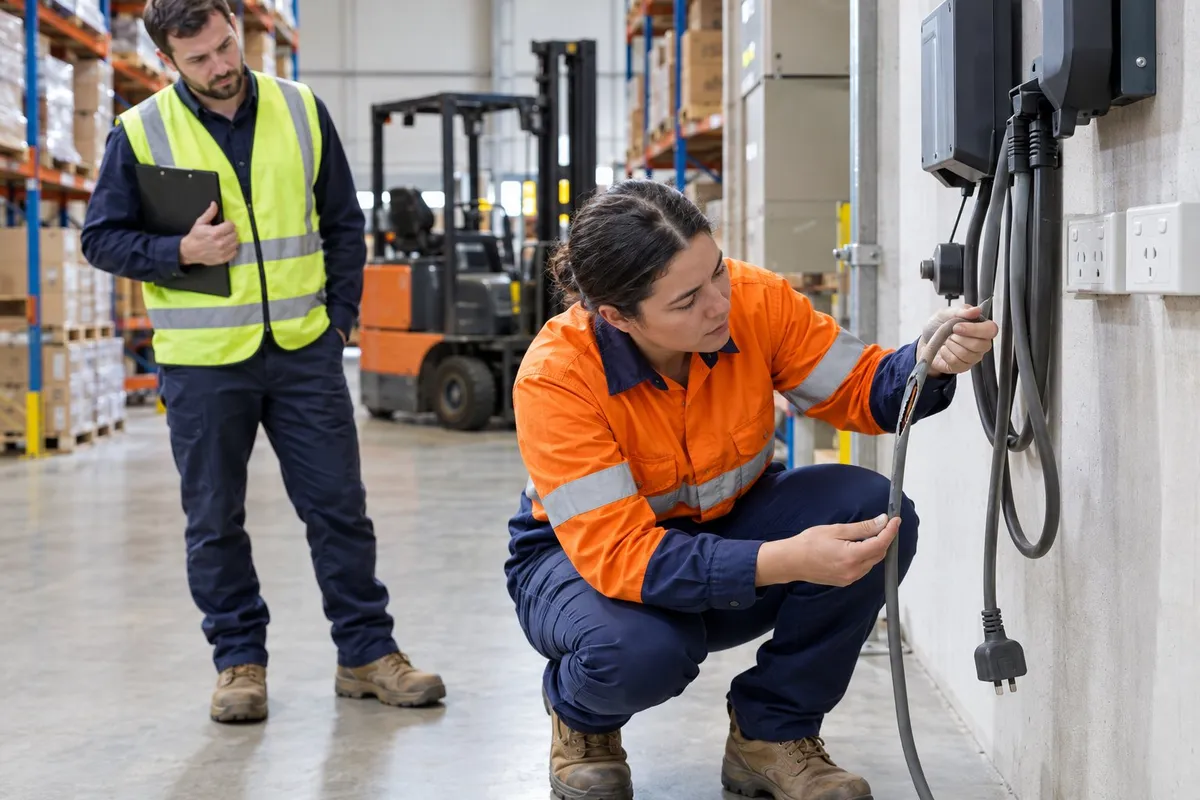
Electrical Risk Is Not Just an Electrician's Problem
A cleaner notices the floor polisher lead feels warm, but finishes the shift anyway.
A storeperson resets a tripped safety switch so the forklift charger keeps going.
A farmhand runs an extension lead across a wet shed floor to power a pump.
After a storm, a maintenance worker heads out to clear debris near a water-damaged switchboard.
None of these workers is an electrician. Every one of them is managing an electrical risk.
There is a common assumption that electrical safety belongs to the sparkies. New research suggests that assumption is leaving a lot of workers exposed.
Electrical risk is not just an electrician's problem. It sits in ordinary equipment, used by ordinary workers, every day.
The Workers Being Hurt Are Not Always the Ones You Expect
In October 2026, researchers from the Monash Centre for Occupational and Environmental Health published an analysis of Victorian coroner-reported deaths, emergency department presentations, hospital admissions and workers' compensation claims for work-related electrical injuries between 2018 and 2024, as reported by Safety Solutions.
Manufacturing workers accounted for around one in five of the 285 accepted compensation claims for electrical injury. Construction accounted for 16.1%. By occupation, electrotechnology and telecommunications trades workers lodged the most claims at 16.5%, followed closely by labourers such as freight handlers and shelf fillers at 13%.
Lead researcher Dr Dee Tomic said a large share of these injuries were happening to workers who had most likely never been trained to work around electricity. Electricians are exposed more often, but they work within licensing, isolation and testing systems. Other workers meet live equipment unpredictably and without that structure around them.
The data is Victorian, and the researchers note it probably underestimates the true number. But there is little reason to think Queensland workplaces look very different.
Why Everyday Electrical Risk Gets Missed
Electrical risk rarely looks dramatic until something goes wrong. In most workplaces it hides in plain sight.
Ordinary equipment. Extension leads, power boards, battery chargers, portable tools, pumps, kitchen appliances and cleaning machines.
Normalised faults. The lead that is "always a bit warm", the switch that "trips every now and then", the cable held together with tape.
Improvised fixes. Resetting a safety switch again and again, swapping a plug, joining two leads to reach further.
Changing conditions. Water, heat, dust, vibration, vehicle traffic and storm damage all change how safe equipment really is.
Most of these situations do not involve a licensed electrical worker at all. They involve cleaners, storepersons, kitchen staff, farm workers, labourers and supervisors making quick decisions to keep work moving. If those people have never been shown what an electrical fault looks like, or told what they must not touch, the system is relying on luck. As we covered in A Training Card Is Not the Same as Site-Ready Competency, holding an induction or ticket is not the same as being able to recognise a hazard in the moment.
What Queensland Law Expects
Queensland manages electrical safety through the Electrical Safety Act 2002 alongside the Work Health and Safety Act 2011.
Under section 30 of the Electrical Safety Act, a person conducting a business or undertaking (PCBU) must ensure the business is conducted in a way that is electrically safe, including that electrical equipment used in the business is electrically safe. Workers also have duties under section 39 to take reasonable care for their own electrical safety and to follow reasonable instructions and procedures.
The Electrical Safety Regulation 2026 commenced on 1 September 2026, replacing the 2013 Regulation. Section 12 requires PCBUs to manage electrical risks in line with the risk management process in the WHS Regulation. The inspection, testing and safety switch requirements then depend on the type of work. For example, electrical equipment used for construction work must comply with AS/NZS 3012 (section 140), while manufacturing, service and office, and rural industry work each have their own requirements (sections 133 to 141).
Training sits under the WHS Act too. Section 19(3)(f) requires PCBUs to provide the information, training, instruction or supervision necessary to protect workers from risks arising from the work, so far as is reasonably practicable.
If your electrical procedures, testing schedule or SWMS still refer to the 2013 Regulation, now is a good time to check them against the 2026 version.
Storm Season Adds Another Layer
Queensland's storm season brings a predictable spike in electrical exposure for workers who do not normally think about it. Grounds staff, farm workers, maintenance crews and clean-up teams can find themselves working near fallen lines, wet equipment or damaged switchboards.
The Queensland Electrical Safety Office advises people to report fallen, low or damaged powerlines and stay away from them, not to touch switchboards damaged by water or fire, and to leave electrical work to licensed electricians. Damaged installations may also need verification testing by a licensed electrician before they are reconnected.
Those messages need to reach workers before the first storm, not after it. If your work brings plant or long tools near overhead lines during clean-up, our earlier article on working near powerlines covers the planning questions to ask first.
What This Means For You
Owners, managers and supervisors can make a real difference here without turning everyone into an electrician.
Map where non-electrical workers meet electricity. Chargers, leads, pumps, kitchens, cleaning gear, portable tools and switchboard areas.
Check your testing and safety switch arrangements against the type of work you do under the 2026 Regulation, not the 2013 version.
Make reporting simple. A damaged lead, a warm plug, a tingle or a repeatedly tripping switch should mean tag it, take it out of service and report it.
Be clear about what workers must not do. No repairs, no opening switchboards, no resetting a switch over and over to keep working. Treat it like any other isolation decision, as we explored in Conveyor Maintenance Needs Isolation, Not Assumptions.
Brief crews for storm season. What to do with fallen lines, wet equipment and damaged switchboards, and who to call.
Include electrical hazard awareness in inductions and toolbox talks for every worker, not just the trades.
The Real Lesson
The workers closest to everyday electrical risk are often the least trained to recognise it. They are not the problem. They are part of the system, and the system needs to give them clear information, simple reporting and safe equipment.
Electrical safety works best when it is built into ordinary work, not left to the person with the licence.