




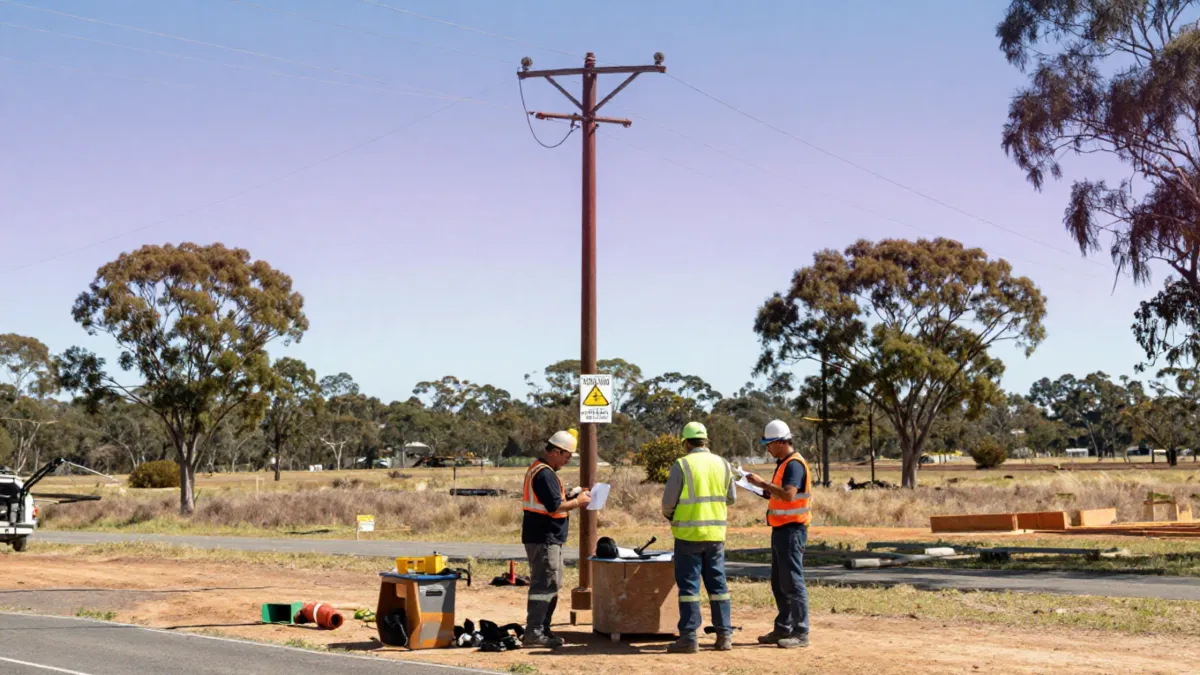
Working Near Powerlines Needs More Than a Warning
Most people do not need convincing that powerlines are dangerous.
They already know.
That is part of what makes this risk so easy to underestimate.
Because when a hazard is familiar, visible, and talked about often, there can be an assumption that it is being managed properly.
But knowing a hazard exists is not the same as controlling it.
A recent Victorian court matter, reported by WorkSafe Victoria, involved a civil construction company that was originally fined $15,000 without conviction after a worker suffered an electric shock near overhead powerlines. After an appeal, the sentence was set aside, the company was convicted, and the fine increased to $90,000.
The penalty is attention-grabbing.
But the bigger lesson is more practical.
This was not a strange or complicated risk. It involved overhead powerlines, a long aluminium pole, and work being carried out close enough for electricity to either make contact or arc.
That is the part worth sitting with.
The hazard was not hidden.
The consequences were not minor.
And the controls needed were not unusual.
The Danger Is Not Always That People Do Not Know
Electrical risk is one of those areas where “awareness” can give a false sense of safety.
People know powerlines are dangerous.
They know electricity can kill.
They know metal conducts electricity.
But on a real job, the risk can start to feel more ordinary.
The work has to keep moving.
The task looks simple.
The line is above, not directly in the way.
The tool is being used quickly.
Everyone assumes everyone else understands the danger.
That is where the gap opens.
Not because people do not care.
But because the system relies too much on memory, judgement, and habit in a situation where the margin for error is very small.
This is why workplace safety cannot rely on common sense alone. As we explored in The Hidden Blueprint: 5 Surprising Truths About Australian Construction Safety, practical WHS systems need to hold up beyond assumptions, habits, and what people think they already know.
Powerline Risk Is Not Just About Touching the Line
One of the most dangerous assumptions around overhead powerlines is that the risk only exists if something physically touches the line.
That is not how electrical risk works.
Electricity can arc across a gap. It can travel through conductive tools, plant, machinery, and materials. A worker does not need to deliberately touch a powerline to be seriously injured.
That matters when work involves:
aluminium poles
ladders
scaffold components
cranes
tipper trucks
excavators
elevated work platforms
irrigation equipment
long-handled tools
loading and unloading near overhead lines
In the reported case, the worker was using a seven-metre aluminium pole to measure the depth of a bore shaft. That kind of detail matters because it shows how quickly a routine task can create exposure when the work is near live electrical infrastructure.
The issue is not just the presence of a powerline.
It is the combination of the powerline, the task, the tool, the distance, the worker’s position, the conditions on the day, and the controls that are actually in place.
Safe Systems Are Not Just Documents
The phrase “safe system of work” gets used so often that it can start to sound like paperwork.
But on site, a safe system of work is not just a document.
It is the way the job is actually planned, communicated, controlled, supervised, and adjusted when conditions change.
For electrical risks near overhead powerlines, that means asking practical questions before the task starts:
Where are the powerlines?
How close will the work get?
What tools, plant, or materials could enter the danger zone?
Are minimum approach distances clear?
Are exclusion zones marked and understood?
Who is supervising the work?
What happens if the task changes?
What happens if the weather changes?
What happens if a different tool is used?
Those questions are not complicated.
But they need to be asked before the work starts, not after something has gone wrong.
The Problem With “Everyone Knows”
Some of the most serious risks on a worksite are the ones people think are already covered.
Powerlines are a good example.
They are visible.
They are known.
They are often included in pre-starts, site plans, and risk assessments.
But the real test is not whether they were mentioned.
The real test is whether the controls were strong enough to influence the work.
Could a worker accidentally enter the exclusion zone?
Could a long tool be lifted into a dangerous area?
Could a truck tipper body rise near lines?
Could a spotter be distracted?
Could someone new to site misunderstand the risk?
Could a delivery driver be exposed at the site entrance?
Could wind, heat, poor light, or access pressure change the risk?
If the answer is yes, then awareness is not enough.
The control needs to be more active than that.
It is one reason visible hazards can still be poorly controlled. A site can look organised on the surface while serious operational risks are sitting in plain view, which is something we unpacked further in The Sites That Looked Safest Sometimes Worried Me the Most.
This Is Not Just a Construction Issue
The reported case involved civil construction, but the lesson applies well beyond construction.
Overhead powerlines and electrical infrastructure show up across many industries.
In agriculture, powerline risk can appear during irrigation work, harvesting, fencing, loading, or moving tall equipment.
In transport and logistics, it can show up in yards, delivery areas, and loading zones.
In local government and maintenance work, it can appear during tree work, signage, road repairs, and asset inspections.
In manufacturing and warehousing, it can show up in outdoor storage areas, high-reach work, and plant movement.
In small businesses, it can appear during simple maintenance tasks that no one thinks of as high risk until the wrong tool is used in the wrong place.
Different industries.
Same principle.
If people, plant, tools, or materials can come close to live electrical infrastructure, the risk needs to be actively managed.
What This Means For You
If your business does any work near overhead powerlines, the key question is not:
“Do our people know powerlines are dangerous?”
They probably do.
The better question is:
“What stops them from getting too close?”
That is where the strength of the system becomes clear.
It is not enough to rely on workers remembering. It is not enough to point out the lines during induction. It is not enough to assume experienced operators will manage the risk as they go.
Good electrical risk management needs clear, practical controls that match the actual work being done.
That includes the site layout, the equipment being used, the task method, the people involved, and the conditions on the day.
The more routine the work feels, the more important that becomes.
Because routine work is where assumptions grow.
Practical Checks Before Work Starts
Before work begins near overhead powerlines, take time to check the basics properly.
Identify all overhead powerlines, including those near access points, delivery areas, storage zones, and travel paths
Confirm minimum approach distances before work starts
Mark exclusion zones clearly so they are visible and understood
Avoid conductive tools or materials near live electrical infrastructure wherever possible
Use spotters where plant, equipment, or materials could come close to powerlines
Brief workers, contractors, and delivery drivers on the specific risk for that site
Consider weather, visibility, ground conditions, and changes in the work method
Stop and review the task if the tool, equipment, access, or work position changes
These controls are not glamorous.
They are not complicated.
But they need to be deliberate.
They need to be understood.
And they need to be checked in the real work environment, not just written into a procedure.
The Real Cost of Assumption
The fine in this case increased significantly after appeal, but the financial penalty is only one part of the story.
A worker was seriously injured.
A business was convicted.
A known hazard became a life-changing event.
That is the real issue.
Electrical risk does not need to be dramatic to be dangerous. A simple task, a familiar site, a long conductive object, and a moment too close to overhead lines can be enough.
That is why working near powerlines needs more than a warning.
It needs planning.
It needs controls.
It needs supervision.
It needs people willing to stop and reassess when the job changes.
And most of all, it needs businesses to stop relying on “everyone knows” as if that is the same as a safe system of work.
If you are not sure whether your current controls for electrical risks are clear, practical, and actually working on site, now is the time to take a closer look.