




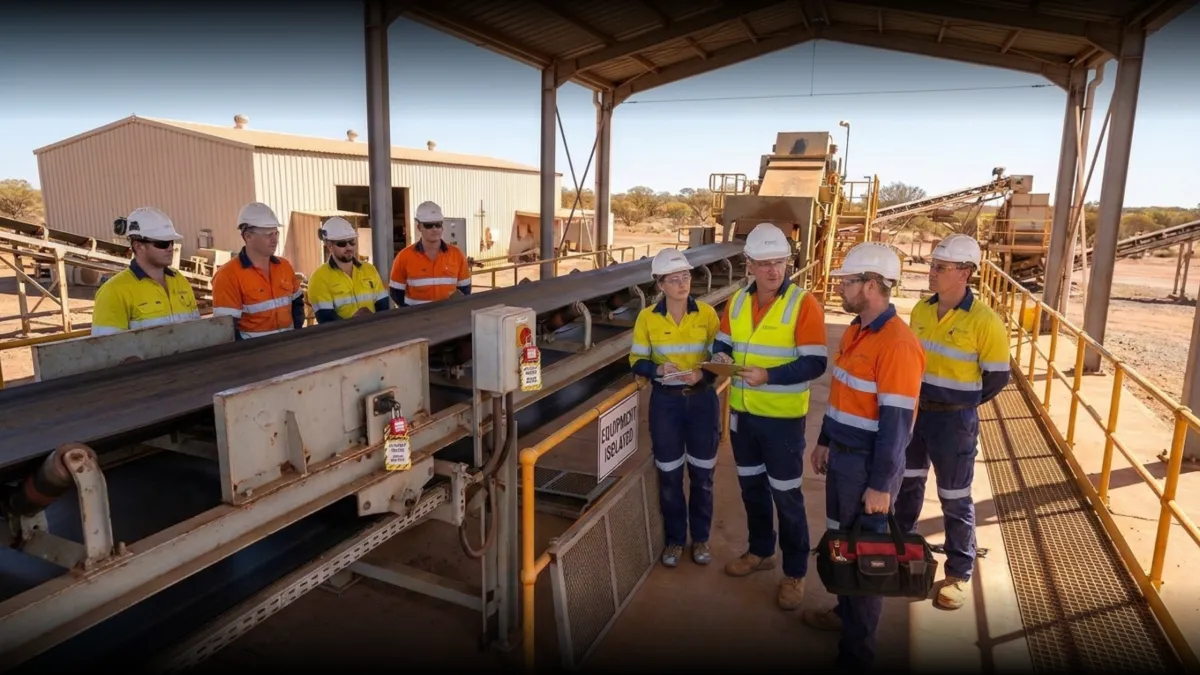
Conveyor Maintenance Needs Isolation, Not Assumptions
Conveyors are easy to underestimate because they are so familiar.
They move materials.
They run in the background.
They are part of the normal rhythm of many sites, plants, yards, factories, farms, mines and processing areas.
But when something goes wrong around a conveyor, the consequences can be serious very quickly.
That is why a recent WorkSafe WA matter is worth paying attention to. WorkSafe WA reported that a mine operator was fined $200,000 and ordered to pay costs after a contractor’s worker became entangled in a stacker conveyor while carrying out maintenance at a gold mine near Kalgoorlie.
The point is not to turn this into an incident recap.
The point is to look at what this type of event reminds every workplace.
Conveyor maintenance is not ordinary work just because conveyors are used every day.
When people need to clean, clear, adjust, inspect, repair or work near moving plant, the risk changes.
That work needs clear isolation, effective guarding, practical supervision and strong coordination between everyone involved.
A Conveyor Does Not Have to Look Dangerous to Be Dangerous
Many conveyor risks are not dramatic from a distance.
A nip point might be partly hidden.
A roller may look slow.
Material build-up may look like a simple housekeeping issue.
A blocked area may seem like something that can be cleared quickly.
A side access point may appear convenient for a small adjustment.
That is where the risk can sit.
The danger is not only the conveyor belt itself. It can be the moving parts around it, the tail drum, rollers, pulleys, belt tension, pinch points, access ports, stored energy and the way workers interact with the equipment when something is not running smoothly.
A conveyor may look like part of the background until a person reaches into the wrong area, tries to clear material, stands too close, or works around a guard that does not properly control the risk.
That is why conveyor safety needs more than familiarity.
It needs physical controls and clear work methods that match the real task.
Maintenance Changes the Risk
A conveyor operating normally is one thing.
A conveyor being cleaned, cleared, adjusted or maintained is another.
Maintenance often brings people closer to moving parts. It can involve awkward access, pressure to get production moving again, material build-up, guards being opened or removed, and workers trying to diagnose a problem while the system is still live.
This is where assumptions become dangerous.
“It will only take a second.”
“I just need to clear that build-up.”
“I can reach it from here.”
“We have done this before.”
“The conveyor is moving slowly.”
“It is easier if we leave it running.”
Those are the kinds of thoughts that can appear when the work feels routine or urgent.
But conveyor maintenance should never rely on someone judging that a quick reach, quick clean or quick adjustment is safe enough.
If a worker needs to access a danger area, the system needs to stop the movement, isolate the energy and make the work safe before the task begins.
Isolation Is Not a Formality
Isolation is one of the most important controls in maintenance work, but it can lose meaning if it becomes a paper exercise.
Real isolation is not just a step in a procedure.
It is the control that stops machinery from moving, starting, releasing energy or exposing someone while work is being done.
For conveyor work, this may mean considering:
electrical energy
mechanical movement
belt tension
gravity and stored material
hydraulic or pneumatic systems
stored energy in moving or tensioned parts
connected plant or upstream and downstream equipment
who can restart the system
whether the isolation has been tested before work begins
The key question is not simply: “Has the isolation form been completed?”
The better question is: “Can this equipment move, start, release energy or expose someone while the work is being done?”
That is the question that matters on site.
Guarding Needs to Match Real Access
Guarding is another area where workplaces can get a false sense of confidence.
A conveyor may have guards fitted, but that does not automatically mean the risk is controlled.
The guard needs to prevent access to dangerous parts during normal operation and foreseeable work. It also needs to stay effective when people are cleaning, inspecting, clearing blockages or carrying out maintenance.
If workers can reach through, around, under or behind a guard into a danger area, the control may not be doing what it needs to do.
If a guard has to be removed regularly for routine tasks, the task needs to be reviewed.
If access ports allow people to reach moving parts, the design needs attention.
If guarding gets bypassed because it makes common maintenance tasks difficult, the business has useful information. It means the work system and the plant design may not be aligned.
The answer is not to blame workers for working around poor access.
The answer is to review why the workaround exists and how the task can be made safe.
Contractors Must Be Part of the System
The WorkSafe WA matter involved a contractor’s worker, which is an important detail for workplaces to consider.
Contractor work can create gaps if responsibilities are assumed rather than made clear.
The site operator may assume the contractor understands the plant.
The contractor may assume the site has safe access and isolation arrangements in place.
A supervisor may assume another person is responsible for the work method.
A worker may assume the task has already been assessed because the job has been assigned.
Those assumptions are not enough.
When contractors are working on or near conveyors, the site needs clear coordination.
Who controls the plant?
Who authorises isolation?
Who verifies it has been tested?
Who confirms the work method?
Who supervises the task?
Who communicates changes?
Who can stop the work?
These questions should be answered before the job begins, not after something has gone wrong.
Supervision Is More Than Being Nearby
Supervision around conveyor maintenance is not just about having someone on site.
It is about making sure the task is being done in line with the actual risk.
A supervisor needs to understand the plant, the maintenance task, the isolation requirements, the guarding arrangements, and the points where work may change.
They also need to notice when pressure starts to shape decisions.
Is production waiting?
Is the job taking longer than expected?
Is material still building up?
Has access turned out to be harder than planned?
Are workers trying to diagnose a fault while plant is running?
Has the task changed from inspection to cleaning, clearing or adjustment?
Those moments matter because risk can increase when the job changes but the controls do not.
Good supervision helps keep the work connected to the hazard, not just the schedule.
This Is Not Just a Mining Issue
The source matter involved a mine site, but conveyor entanglement risk is not limited to mining.
Conveyors appear across many industries.
In construction materials and quarrying, they may move aggregate, sand, gravel or crushed material.
In manufacturing, they may move products, components, packaging or waste.
In agriculture, they may be used in grain handling, packing, feed systems or processing areas.
In logistics, they may support sorting, loading, unloading and distribution.
In recycling and waste, they may move mixed material where blockages and manual intervention are common.
In food processing, they may run through cleaning, inspection and production areas.
Different industries. Same pattern.
If workers need to clean, clear, adjust, inspect or maintain moving plant, the risk needs to be controlled before someone is close enough to be harmed.
This is why conveyor risk deserves repeated attention. We have previously discussed in The Conveyor Risk Most Sites Overlook — And Why It’s Not Just a Factory Problem that conveyor hazards are often familiar, visible and still underestimated.
Maintenance work makes that issue even more important.
What This Means For You
If your workplace uses conveyors, the key question is not: “Do we know conveyors can be dangerous?”
Most people do.
The better question is: “What stops someone from reaching, cleaning, clearing or adjusting the conveyor while it can still move?”
That is where the strength of the system becomes clearer.
Look at the real work, not just the procedure.
Where does material build up?
Where do blockages happen?
Where do workers need access?
Where are guards removed?
Where are access points located?
Who performs maintenance?
Who manages contractors?
Who authorises isolation?
Who checks that isolation has worked?
Who supervises the job when pressure is building?
These are practical questions, and they are worth asking before the next maintenance task.
Practical Checks for Conveyor Maintenance
If workers or contractors clean, clear, inspect, adjust or maintain conveyors, review the basics properly.
Identify all nip points, rollers, pulleys, belts, drums, tension points and access areas
Review where material build-up, blockages or routine clearing tasks occur
Confirm guarding prevents access to dangerous moving parts
Check whether guards, access ports or openings allow reach into danger areas
Make sure isolation procedures cover all relevant energy sources
Test isolation before work begins, not after the task has started
Confirm who controls the plant when contractors are performing work
Make supervision responsibilities clear before maintenance starts
Review any workaround, bypass or “quick fix” that workers rely on to get the job done
Stop and reassess if the task changes from inspection to clearing, cleaning, adjustment or repair
These checks are not about slowing work down for the sake of it.
They are about making sure nobody is asked to solve a plant problem by putting themselves near moving machinery.
The Real Lesson
Conveyor maintenance can feel routine because conveyors are part of everyday work.
That is exactly why assumptions are dangerous.
The machine is familiar.
The build-up looks minor.
The task feels quick.
The access point looks convenient.
The pressure to get moving again feels normal.
But none of that controls the hazard.
When maintenance work brings people close to moving parts, the system has to do more than rely on experience, judgement or speed.
It needs isolation that works.
It needs guarding that prevents access.
It needs supervision that understands the task.
It needs contractor coordination that removes doubt.
And it needs leaders who treat routine maintenance as real risk, not an interruption to production.
If your workplace uses conveyors or other moving plant, now is a good time to check whether your maintenance controls work in practice.