




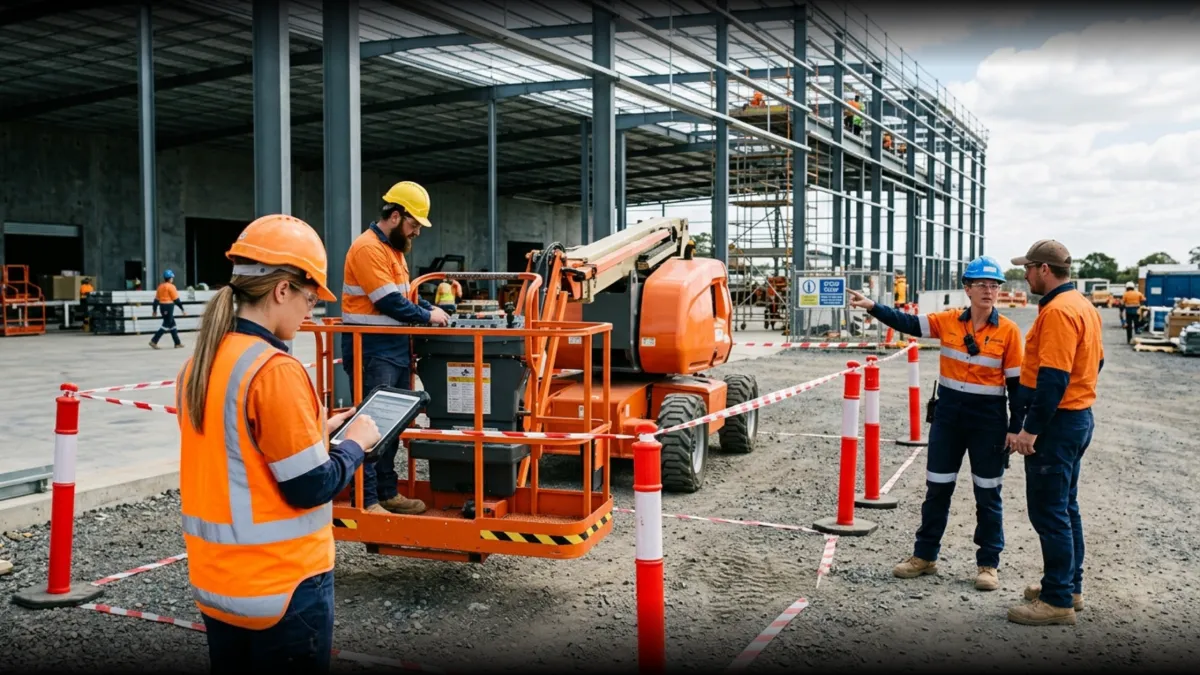
A Training Card Is Not the Same as Site-Ready Competency
A training card is important.
It can show that a worker has completed training for a certain type of equipment or task.
But it does not answer every safety question.
It does not tell you whether that worker is ready for this machine, on this site, in today’s conditions, with the task pressure sitting in front of them.
That is why recent changes in mobile elevating work platform training are worth paying attention to.
The Elevating Work Platform Association has updated the Yellow Card training program in response to revised Australian Standards and changes in modern EWP technology. The update includes clearer machine categories, more information on major hazards such as electrocution, and expanded guidance around newer safety technologies.
Those details matter.
But the bigger lesson is not only about EWPs.
The bigger lesson is that competency is not a one-time event.
Equipment changes. Worksites change. Standards change. Workers move between machines, employers, contractors and site conditions.
A training record might stay the same, but the risk around the work can shift.
That is where businesses need to be careful.
Training Is a Starting Point, Not the Whole System
Training is one part of competency.
It gives workers foundation knowledge. It helps them understand equipment, hazards, basic operation and expected controls. It also gives businesses a way to confirm that a worker has completed recognised instruction for a particular scope of work.
That matters.
But training should not be treated as the final safety check.
A worker may have completed training years ago. They may have trained on a different model of equipment. They may have limited experience in tight access areas, uneven ground, high winds, nearby powerlines, pedestrian traffic or changing site layouts.
None of that means the worker is careless.
It means the business still needs to check whether the worker is ready for the actual work.
A card can help answer, “Has this person been trained?”
It does not fully answer, “Can this person safely do this task here, today?”
EWP Risk Depends on More Than the Operator
EWPs are used across construction, maintenance, warehousing, facilities, utilities, mining, agriculture and industrial work.
The equipment may look familiar, but the risk can change quickly depending on the job.
Safe Work Australia’s guidance on elevating work platforms highlights the importance of managing hazards such as ground conditions, overhead hazards, traffic, environmental conditions, maintenance, training and supervision.
That list matters because it shows why competency is not only about knowing how to operate the controls.
An operator also needs to understand the work area.
Is the ground firm and stable?
Is the EWP suitable for the task?
Are there overhead structures, trees or powerlines?
Are there pedestrians, vehicles or other mobile plant nearby?
Could weather affect stability?
Are exclusion zones clear?
Has the machine been inspected and maintained?
Has the route to the work area been checked?
The operator has a role in those questions, but they should not be left to carry the whole system alone.
Planning, supervision, equipment selection and site controls all matter.
The Equipment Might Have Changed Since the Training
Modern plant does not stand still.
EWPs can include different control systems, safety features, sensors, cut-outs and machine-specific operating limits. These features may support safer work, but they do not remove the need for judgement.
In some situations, they can also create a new gap.
A worker might know how to operate one type of scissor lift but be less familiar with another model.
A worker might understand the basics of a boom lift but not the limits of a specific machine.
A worker might know what a safety feature does but not what to do when it activates.
A worker might rely too heavily on a system without understanding its limitations.
That is why refresher learning, pre-start conversations and practical observation still matter.
The question is not only whether someone has been trained.
It is whether their knowledge is current enough for the equipment being used.
Site Conditions Are Part of Competency
A person can be competent in one environment and still need support in another.
An EWP being used on a clean warehouse floor is not the same as an EWP being used on a civil site with changing ground conditions.
A machine operating indoors is not the same as one operating outdoors in wind, rain or heat.
A straightforward lift is not the same as work near overhead powerlines, roof edges, trees, structures, traffic or other plant.
That is where businesses sometimes rely too heavily on the training record.
They see the card and assume the worker is ready.
But site-ready competency means the worker understands the task, the machine and the environment.
It also means the supervisor knows what to look for before the work starts.
This is especially important around overhead hazards. We have already discussed in Working Near Powerlines Needs More Than a Warning that knowing a hazard exists is not the same as having practical controls that work in the real conditions of the job.
The same thinking applies here.
If an EWP is being used near powerlines, structures, traffic or unstable ground, the training card is only one part of the picture.
Verification Should Be Practical
Verification of competency does not need to become a complicated exercise.
But it does need to be real.
It should go beyond collecting a copy of a card and filing it away.
A practical approach might include checking:
what equipment the worker is trained to use
whether that matches the EWP being used
how recently the worker has used similar equipment
whether they understand the main hazards for this site
whether they can complete pre-start checks properly
whether they can explain operating limits and exclusion zones
whether they know what to do if conditions change
whether a supervisor has observed them operating safely in real conditions
The point is not to make workers prove themselves over and over without reason.
The point is to make sure the business has enough confidence that the worker can do the job safely.
That confidence should be based on evidence, not assumption.
Contractors and Hire Equipment Need Extra Attention
Competency gaps often appear when contractors, labour hire workers, subcontractors or hired equipment enter the picture.
A business may assume the contractor has handled training.
The contractor may assume the worker’s previous experience is enough.
The site team may assume the machine is familiar.
The worker may assume the controls are the same as the last model they used.
That is a lot of assumptions sitting around one piece of plant.
This is where simple checks can prevent bigger problems.
Before work starts, confirm the equipment type, the worker’s training scope, the site conditions, the planned task, the supervision arrangements and who has authority to stop the work if something does not look right.
These are not admin details.
They are part of the control.
What This Means For You
If your business uses EWPs or other mobile plant, the key question is not:
“Do we have the training records?”
The better question is:
“Do we know our people are competent for the work they are doing now?”
That includes employees, contractors, supervisors and anyone else involved in planning or controlling the work.
A training card can be part of the answer, but it should not be the whole answer.
Businesses need systems that keep competency current, visible and connected to the real work.
That means looking at equipment, tasks, site conditions, supervision and how workers are supported when conditions change.
Practical Checks Before the Work Starts
Before EWP work begins, take time to check the basics properly.
Confirm the EWP type is suitable for the task and site conditions
Check that the operator’s training matches the equipment being used
Review ground conditions, access routes, overhead hazards, traffic and exclusion zones
Confirm the EWP has been inspected, maintained and is fit for use
Make sure the operator understands the task, operating limits and site-specific hazards
Observe new or unfamiliar operators in real conditions before assuming capability
Clarify who is supervising the work and who can stop it if conditions change
Review near misses, maintenance issues and operator feedback as part of competency management
These checks are not about mistrusting workers.
They are about making sure the system does not rely on a card to do more than it can.
The Real Lesson
The EWP training update is a useful reminder that work keeps changing.
Equipment changes.
Standards change.
Technology changes.
Site conditions change.
The way people learn and retain information changes too.
Good training matters, but training only works when it is supported by planning, supervision, observation and practical review.
A training card can tell you something useful.
It cannot tell you everything.
If your business relies on EWPs, mobile plant or high-risk equipment, now is a good time to check whether your competency process is doing more than collecting records.