




1 December Is Too Late to Start Thinking About Airborne Exposure
Some workplace hazards are easy to see.
A missing guard.
An unprotected edge.
A vehicle moving through a pedestrian area.
Airborne exposure is different.
Dust, fumes, vapours, gases and mists can be created during ordinary work without producing an immediate incident. Some are visible. Others are difficult to detect without the right assessment or monitoring.
The harm can also develop over time.
That makes airborne contaminants particularly relevant during National Safe Work Month Week 2, which focuses on “For health: what WHS protects” and specifically highlights harmful substances and airborne contaminants as workplace health risks.
There is another reason workplaces should be looking at this now.
Australia is transitioning from the current Workplace Exposure Standards for Airborne Contaminants, or WES, to the new Workplace Exposure Limits, or WEL, from 1 December 2026. Until 30 November, workplaces must continue complying with the current WES requirements. From 1 December, the new WEL list takes effect.
The date matters.
But 1 December should not be the day a workplace first starts asking what people are breathing.
Start With What the Work Is Putting Into the Air
Airborne contaminants are not limited to businesses that store drums of hazardous chemicals.
Work processes themselves can generate exposure.
Cutting, grinding, welding, sanding, spraying, crushing, mixing, cleaning, machining, operating diesel equipment and moving dusty materials can all change the air around workers.
The source will look different across industries.
Construction and civil work may involve concrete dust, welding fumes, diesel exhaust or coatings.
Manufacturing might generate metal fumes, vapours, wood dust or process emissions.
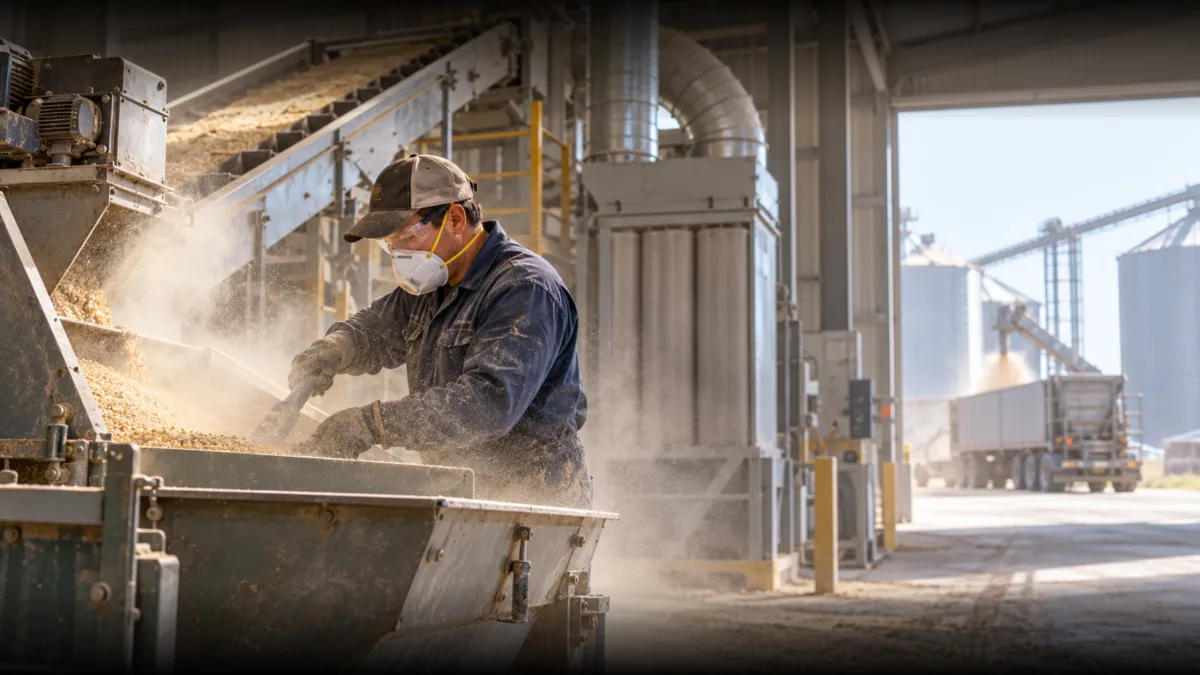
Agriculture can involve dust from grain, soil, feed, chemicals and diesel-powered machinery.
Transport and logistics workers may be exposed to diesel emissions around loading areas, depots and maintenance facilities.
Vehicle workshops, mines, quarries, processing plants and maintenance teams can face their own combinations.
The first question is therefore not simply, “Do we use hazardous chemicals?”
It is, “What does our work generate, and who could be breathing it?”
That question can reveal exposures that a chemical register alone will not.
What Actually Changes on 1 December?
The move from WES to WEL is not simply a new acronym.
The terminology is changing
Safe Work Australia says the term Workplace Exposure Limits is intended to make it clearer that these values are limits that must not be exceeded, rather than best-practice targets.
Some listings, limits and notations are changing
The transition also includes changes to some individual exposure limits, additions and removals of listings, and updated advisory notations.
Not every contaminant is changing.
For example, Safe Work Australia confirmed in June 2026 that the exposure levels for nine chemicals, including respirable crystalline silica, formaldehyde and benzene, will remain at their current WES levels when the WEL transition takes effect, pending further work. [Read more]
That is why workplaces need to check the actual WEL list and comparison material rather than assuming every contaminant has a new number.
The Legal Duties Already Exist
The transition date is important, but the duty to manage airborne exposure is not new.
Under the model WHS Regulations, regulation 49 requires a PCBU to ensure that no person at the workplace is exposed to a substance or mixture above its applicable airborne exposure standard.
Regulation 50 requires air monitoring where the PCBU is not certain, on reasonable grounds, whether the airborne concentration exceeds the relevant standard, or where monitoring is necessary to determine whether there is a risk to health. Air-monitoring records must also be kept for 30 years and made accessible to people who may be exposed.
From 1 December, the model law terminology shifts to the WEL framework through the 2026 amendments. Because WHS laws are implemented by the Commonwealth, states and territories, businesses should also confirm how the transition applies in their own jurisdiction. [Read more]
The practical point is simple:
The deadline is about the transition.
The responsibility to understand and control exposure already exists.
Air Monitoring Gives You Information. It Does Not Control Exposure.
Air monitoring can be extremely useful.
It can help determine whether exposure is approaching or exceeding a limit, whether controls are working, whether exposure differs between tasks, and whether further action is required.
But monitoring itself does not reduce exposure.
A result on a report does not remove dust from the air.
A sample does not capture fumes at the source.
A monitoring program does not repair failed ventilation.
The value of monitoring is in what happens next.
If the results raise concerns, the workplace needs to review the work, the source of exposure and the effectiveness of the controls.
Control the Exposure Before Relying on PPE
Once an airborne hazard is understood, the next question is how exposure can be eliminated or minimised.
The hierarchy of controls still matters.
Can the substance or process be eliminated?
Can a less hazardous product or method be substituted?
Can the source be isolated?
Can extraction, enclosure, ventilation or suppression reduce the contaminant before it reaches workers?
Can equipment, sequencing or work location be changed?
PPE, including respiratory protection, may still form part of the control strategy.
But it should not quietly become the entire strategy.
If respirators are carrying most of the burden because extraction is ineffective, suppression is inconsistent or the process itself has never been reviewed, stronger controls may be available.
This connects directly with PPE Has a Working Life. Are You Managing It?. Respiratory protection needs to stay suitable, maintained and appropriate for the actual exposure.
It also reflects the broader control lessons in Welding Safety Is Getting Fresh Attention. Your Controls Should Too and Lead Exposure at Work Is Not Just an Old Paint Problem.
Different contaminants need different controls.
But the principle stays the same.
Knowing the hazard exists is only the beginning.
Diesel Emissions Deserve a Closer Look
Diesel-powered equipment is so common that its emissions can become part of the background of work.
That makes the exposure easy to underestimate.
The risk can change significantly depending on where equipment operates.
A diesel engine running outdoors presents a different exposure situation from the same equipment operating in a tunnel, workshop, enclosed loading area or underground environment.
That is why equipment type alone does not tell you enough.
You need to understand how, where and for how long people may be exposed.
What This Means For You
If your workplace generates dust, fumes, vapours, gases, mists or diesel emissions, do not wait until late November to start reviewing exposure.
Begin with the work.
Identify what is being generated.
Find out who may be exposed and under what conditions.
Check whether the relevant exposure limit or notation changes from 1 December.
Look at whether existing controls are actually reducing exposure.
Consider whether air monitoring is needed to answer questions you cannot otherwise resolve.
And where the exposure or interpretation is complex, involve competent occupational hygiene expertise rather than guessing.
This is not only a construction issue.
The same questions apply across manufacturing, agriculture, mining, transport, logistics, vehicle maintenance, workshops, cleaning, processing and other workplaces where contaminants can be generated through normal work.
A Practical WEL Readiness Check
Before 1 December, review:
What you use or generate: Identify airborne contaminants created by substances and work processes, not only what appears on the chemical register.
What is changing: Compare relevant current WES values, listings and notations against the incoming WEL information.
Who may be exposed: Include employees, contractors and anyone else working near the source.
How exposure happens: Consider duration, frequency, ventilation, enclosed spaces and changing work conditions.
Whether your controls work: Physically check extraction, suppression, isolation, enclosure, maintenance and work methods.
Whether monitoring is needed: Consider the requirements under model WHS Regulation 50 and whether competent advice is needed.
What needs to happen before December: Assign actions, owners and realistic completion dates.
This is not about creating paperwork for a new acronym.
It is about knowing whether the air people are working in is exposing them to preventable harm.
The Real Lesson
The new Workplace Exposure Limits create a clear deadline.
But the bigger issue existed before the deadline was announced.
Workers may already be breathing contaminants created by ordinary work.
The opportunity between now and 1 December is to understand those exposures properly, review the controls and address gaps while there is still time to act deliberately.
That fits directly with National Safe Work Month Week 2.
Protecting health means paying attention to risks that may not produce an immediate injury or obvious warning.
Sometimes the most important safety work is preventing harm that may only become visible years later.