




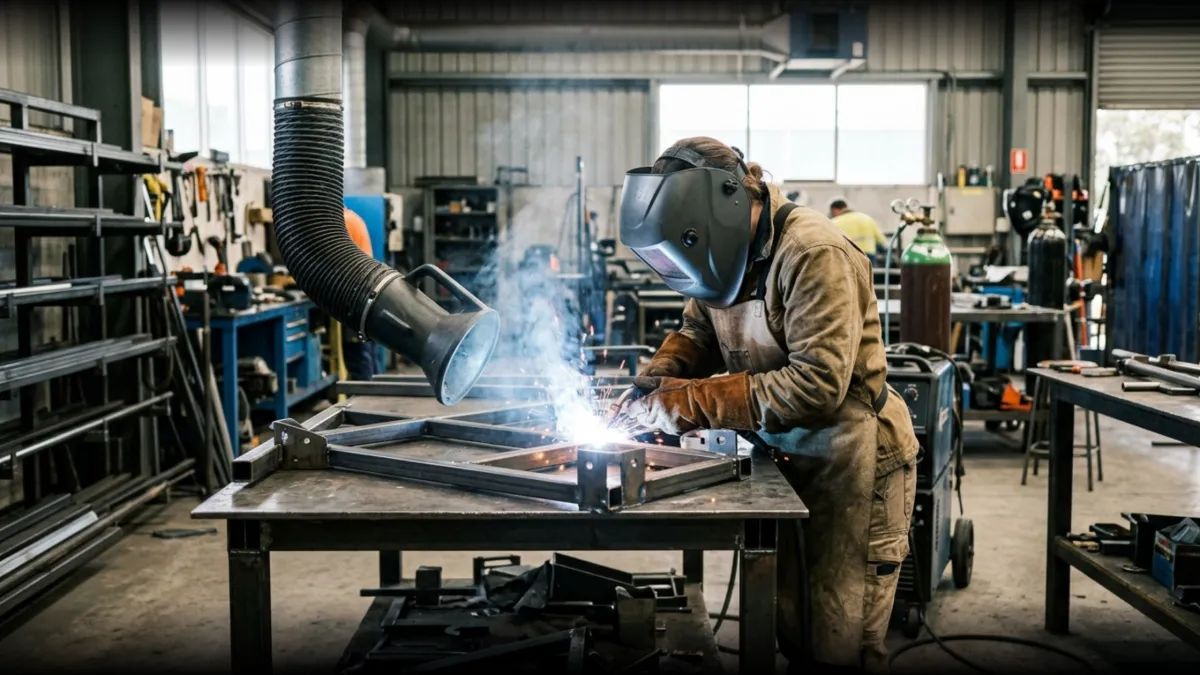
Welding Safety Is Getting Fresh Attention. Your Controls Should Too.
Welding is one of those tasks that can become part of the background.
It happens on construction sites.
It happens in workshops.
It happens during maintenance.
It happens on farms, in fabrication sheds, in transport yards, and around plant and equipment.
Because it is so common, it can start to feel routine.
And once a task feels routine, the risk can become easier to overlook.
That is why the current national focus on welding safety matters.
Safe Work Australia has opened consultation on options to improve how welding processes are managed under WHS laws. That does not mean every business needs to panic or wait for new rules before doing anything.
But it is a useful signal.
Welding risks are getting fresh attention, and workplaces that rely on welding should be taking a closer look at whether their controls still match the work being done.
Familiar Work Can Still Cause Serious Harm
Welding is not a new hazard.
Most people understand there are risks.
There is heat.
There is light.
There are fumes.
There is fire risk.
There may be grinding, cutting, compressed gases, confined spaces, awkward positions, and nearby workers who are not directly involved in the task.
The issue is not that welding hazards are unknown.
The issue is that familiarity can make them feel more controlled than they actually are.
A worker has done the task many times before.
The workshop has always operated that way.
The job only takes a few minutes.
The doors are open, so ventilation is assumed to be enough.
The respirator is available, but not always used.
The hot work process exists, but it is treated as a formality.
That is where risk starts to creep in. Not because people do not care.
But because the system has stopped asking enough questions.
This is the same pattern we see whenever unsafe habits become normal. Familiar work can make risk feel smaller than it really is, which is something we explored further in When Unsafe Becomes Normal: The Cultural Barrier Construction Can’t Ignore.
Welding Fumes Deserve More Attention Than They Often Get
For many workplaces, the most visible welding risks are burns, sparks, fire, or eye injury.
Those risks matter.
But welding fumes are a major part of the picture, especially because the effects may not be immediate.
A person may not feel harmed at the end of the shift.
The job may appear to have gone smoothly.
The weld may be complete, the area cleaned up, and everyone moves on.
But exposure can still build over time.
That is particularly important where welding is frequent, done indoors, carried out in enclosed or semi-enclosed areas, or performed near other workers.
It is also important where the material being welded, surface coatings, cleaning products, or the work environment may change what is in the air.
This is where simple assumptions can become risky.
“Just open the roller door.”
“Just stand back a bit.”
“Just wear a mask if you need one.”
Those statements may sound practical, but they are not a proper assessment of exposure.
The Control Has to Match the Real Task
A welding control that works in one situation may not be enough in another.
Outdoor welding on a clear day is different from welding inside a shed.
Short-duration repair work is different from repeated production welding.
Clean mild steel is different from coated, painted, galvanised, or contaminated material.
Working alone in a workshop is different from welding near other trades, apprentices, labourers, or people passing through the area.
This is where businesses can get caught.
They may have a general welding procedure, but not a task-specific approach.
They may issue PPE, but not check whether it is being used correctly.
They may have ventilation, but not know whether it is actually effective.
They may have a hot work permit, but not connect it properly to fume exposure, fire risk, nearby workers, or changing site conditions.
A control is only useful if it matches the work in front of you.
This Is Not Just a Construction Issue
Construction is an obvious place to talk about welding safety, but it is far from the only one.
In manufacturing, welding may happen every day in the same workshop, which can create ongoing exposure.
In agriculture, repairs may happen in sheds, yards, or field conditions where formal controls are limited.
In transport and logistics, welding may be part of vehicle, trailer, or equipment maintenance.
In mining and heavy industry, welding often sits inside larger shutdown, maintenance, or plant repair work.
In small businesses, it may be one of those “we just get it done” tasks that no one formally reviews unless something goes wrong.
Different industries.
Same issue.
If welding is part of the work, the risks need to be actively managed.
Policy Attention Is Useful, But Practice Is What Matters
Consultations and regulatory reviews are important because they show where expectations may be heading.
But businesses should not wait for policy changes before reviewing a known hazard.
The practical question is not, “What will the final regulation say?”
The practical question is, “Are our welding controls good enough for the work we are doing now?”
That is the question that matters on the ground.
Because if a worker is exposed to fumes, sparks, heat, fire risk, or poor conditions today, the risk exists today.
Waiting for clearer guidance does not remove the need to manage the hazard.
The same principle applies to other familiar high-risk work. As we discussed in Working Near Powerlines Needs More Than a Warning, knowing a hazard exists is not the same as having controls that work in real conditions.
What This Means For You
If welding happens in your workplace, now is a good time to step back and look at the actual task.
Not just the paperwork.
The task.
Where is welding being done?
How often?
On what materials?
In what conditions?
Who else is nearby?
What ventilation is being used?
Is respiratory protection required?
Is it suitable?
Is it fitted properly?
Are workers actually using it?
Are controls checked, or just assumed?
The answers to those questions will tell you far more than a generic procedure sitting in a folder.
For business owners, this is about making sure your systems are not outdated or too general.
For supervisors, it is about checking what really happens during the task.
For workers, it is about making sure controls are practical enough to use consistently.
Good welding safety does not come from one document.
It comes from matching the control to the task and checking that it works in real conditions.
Practical Checks Before Welding Starts
Before welding work begins, take time to check the basics properly.
Identify the material being welded, including coatings, paint, galvanising, or contamination
Check whether the task will create fumes, heat, sparks, fire risk, or exposure to nearby workers
Confirm whether the work is outdoors, indoors, enclosed, or partially enclosed
Review whether existing ventilation or extraction is suitable for the task
Select respiratory protection based on the actual exposure risk, not habit
Separate welding from other workers where practical
Check hot work controls, including fire watch, ignition sources, and nearby materials
Make sure workers understand the controls and can use them without disrupting the task
Review the task if the location, material, duration, or work method changes
None of this needs to be overcomplicated.
But it does need to be deliberate.
Welding should not be treated as low-risk just because it is familiar.
Where Businesses Often Miss the Gap
One of the biggest issues with welding safety is that businesses often look at the control in isolation.
They ask:
“Do we have PPE?”
“Do we have a permit?”
“Do we have ventilation?”
Those are useful questions, but they are not enough.
The better question is:
“Do these controls work together for this task, in this location, with these people, under these conditions?”
That is where the gaps usually show up.
The respirator may be available, but uncomfortable for the duration of the task.
The extraction may exist, but not be positioned properly.
The permit may be completed, but not reflect the actual work area.
The worker may understand the welding task, but not the exposure risk.
The supervisor may assume the control is being followed, but never observe the job.
That is why review matters.
Not as a paperwork exercise, but as a practical check on whether the system is actually working.
The Real Lesson
The national consultation gives businesses a timely reason to look at welding safety.
But the real lesson is much simpler.
Known hazards still need active management.
Welding is familiar, but that does not make it harmless.
It is skilled work.
It is common work.
It is often necessary work.
But it can expose workers and others to serious risks if the controls are too generic, outdated, or assumed.
The businesses that manage this well are not waiting for someone else to tell them welding is hazardous.
They are looking at the task, talking to workers, checking the controls, and making improvements before exposure becomes harm.
That is the practical work.
And it is worth doing now.