




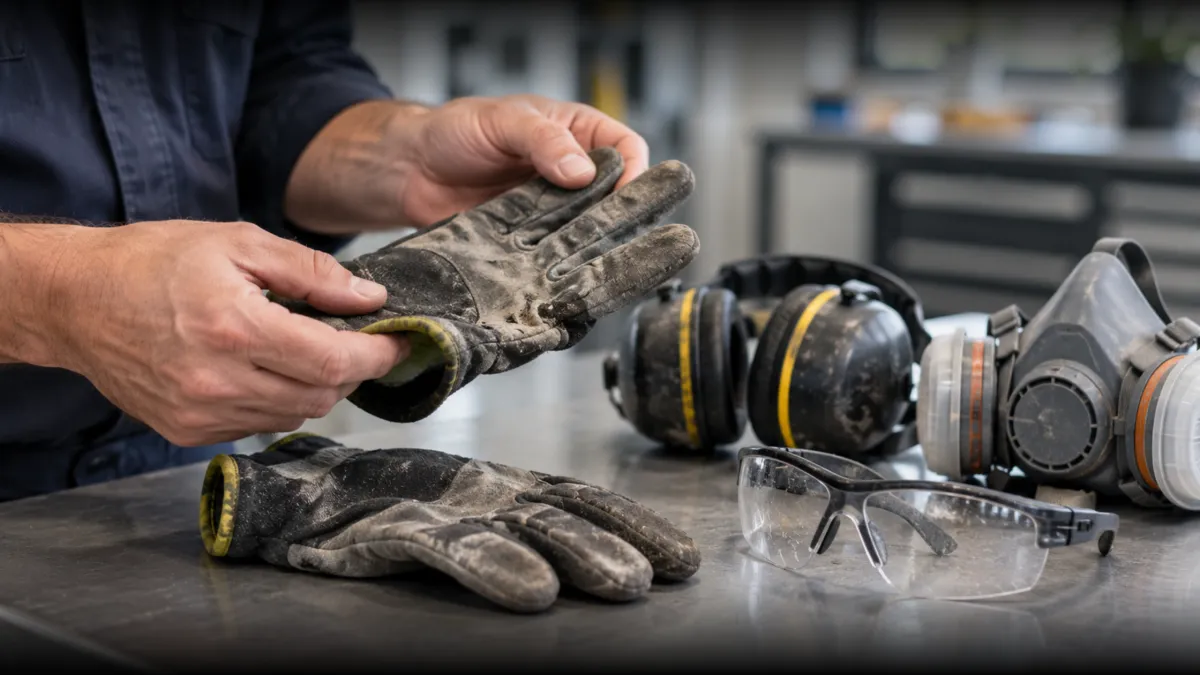
PPE Has a Working Life. Are You Managing It?
A pair of gloves can be exactly right when they come out of the packet.
A respirator can be correctly selected.
Safety glasses can fit properly.
Hearing protection can suit the exposure.
Protective clothing can meet the requirements of the task.
But that does not mean the same equipment will remain suitable indefinitely.
PPE goes to work too.
It gets flexed, dropped, scratched, contaminated, washed, stored in hot vehicles, exposed to chemicals, covered in dust, shared between tasks and used in conditions that may be very different from the ones it was originally selected for.
Eventually, something changes.
Sometimes the damage is obvious. Sometimes it is not.
That is why PPE management should not finish when the equipment is purchased, issued or signed for. The real question is what happens after people start relying on it.
Certification Is the Starting Point
Certification matters.
So does selecting PPE that is appropriate for the hazard, the task and the person using it.
But those decisions are made at a point in time.
The equipment then enters a real workplace.
Safe Work Australia’s PPE guidance says businesses should select suitable PPE for the worker and task and periodically assess whether it is and continues to be effective. Under the model WHS Regulations, regulations 36, 44 and 45 cover risk control and PPE requirements for businesses.
That phrase, "...continues to be effective", is important.
PPE is not a static control. Its condition can change.
The work can change. The hazard can change.
And the person using it may discover things about fit, comfort or performance that were not obvious during initial selection.
Real Work Changes PPE
Protective gloves make this easy to see.
A glove used for general handling might slowly lose grip.
A cut-resistant glove can wear around the areas that repeatedly contact sharp materials.
A chemical-resistant glove may be affected by the substance it is meant to protect against.
Heat, oils, moisture, cleaning products, abrasion and storage conditions can all influence how PPE performs over time.
Damage is not always visible
A hole or broken strap is easy to identify.
Other deterioration can be harder to recognise.
A glove may still look intact while its material has been affected by chemical exposure.
Safety glasses may be scratched enough to interfere with visibility before anyone considers them unusable.
Hearing protection can deteriorate through damage, poor hygiene or worn components.
Respiratory protective equipment can stop providing the intended protection when filters, seals, fit or maintenance are not properly managed.
Protective clothing may continue to look wearable even when contamination, wear or repeated cleaning has changed its condition.
This is why a quick visual check is useful, but it cannot always be the entire inspection process.
The manufacturer’s information, the hazard involved and the consequences of failure all need to inform what workers are expected to check.
Sometimes the PPE Has Not Changed. The Job Has.
There is another lifecycle problem that is easier to miss.
The equipment stays the same while the work changes around it.
A new chemical is introduced.
A different material starts being handled.
A worker moves from occasional splash exposure to longer contact.
Production speeds increase.
A task moves outside into hotter conditions.
A new tool creates a different level of noise, dust or flying material.
The approved PPE may still be sitting in the storeroom.
It may still be in good condition.
It may simply no longer be the right control for the job.
Task changes should trigger another look
This is particularly important when workplaces standardise PPE across multiple jobs.
Consistency can make purchasing and issuing equipment easier, but one item will not necessarily suit every exposure.
A construction worker handling sharp sheet material has different hand-protection needs from someone mixing chemicals.
A cleaner handling a corrosive product has different needs from a warehouse worker moving cartons.
A welder, farm worker, mechanic, laboratory worker and healthcare worker may all wear gloves, eye protection or respiratory equipment, but for completely different reasons.
The selection has to stay connected to the hazard.
We have touched on the same principle in Welding Safety Is Getting Fresh Attention. Your Controls Should Too. PPE may form part of the protection strategy, but it still needs to match the actual exposure and work being carried out.
Replacement Should Not Depend on Someone Finally Complaining
Workers should not have to guess when PPE has reached the end of its useful life.
There should be practical triggers for replacement.
For gloves, that may include tearing, thinning, reduced grip, damage to coatings, contamination, changes in flexibility or exposure beyond the intended use.
For other PPE, the triggers will be different.
The important part is that workers know what to look for and what they are expected to do when something is no longer right.
Safe Work Australia says PPE needs to remain in good working order, be kept clean and hygienic, stored correctly and repaired or replaced when it is not functioning properly.
Replacement also needs to be easy
A good replacement rule is not much use if getting new PPE is difficult.
If replacement stock is locked away, located somewhere inconvenient, routinely questioned or simply unavailable, workers can end up stretching the life of equipment beyond what was intended.
That becomes a systems issue.
A workplace cannot tell people to replace damaged PPE while making replacement difficult.
Look at whether people can actually access the right item when they need it.
Used PPE Can Tell You Something About the Work
There is another opportunity here that workplaces can miss.
Do not only throw worn PPE away.
Look at what keeps happening to it.
If gloves constantly tear in the same place, ask why.
If safety glasses are regularly scratched within days, look at storage and work conditions.
If workers keep reporting that hearing protection interferes with communication, check whether the selection is appropriate.
If respirators are being removed because they are uncomfortable or incompatible with other PPE, that deserves attention.
Patterns in damaged or rejected PPE can tell you something about:
the task
the equipment being used
the environment
the hazard
storage arrangements
compatibility between PPE
whether workers were involved properly in selection
That information can lead to a better PPE choice.
It can also reveal that the bigger problem should be controlled somewhere else.
PPE Still Sits Inside a Bigger Control Strategy
This is an important distinction.
Better PPE management does not mean relying on PPE more heavily.
PPE remains a lower-order control because it does not remove the hazard itself.
Safe Work Australia’s guidance is clear that PPE is used where other control measures have not removed or sufficiently minimised the risk, and PPE still needs to be suitable for the worker, the work and the hazards involved.
If a worker is constantly damaging gloves because they have to reach past a sharp edge, the answer may not be a tougher glove.
If respiratory protection is carrying most of the burden for a dust exposure, there may be opportunities to improve extraction, isolation or the work method.
If hearing protection is uncomfortable for an entire shift, the workplace should still be looking at the noise source.
This is particularly relevant to exposure topics such as Lead Exposure at Work Is Not Just an Old Paint Problem. PPE can matter, but it should sit within a broader approach to controlling exposure.
The PPE lifecycle should therefore trigger two questions:
"Is this equipment still protecting the person?"
And:
"Why are we relying on it in the first place?"
What This Means For You
If your workplace issues PPE, do not treat the issue date as the end of the process.
Look at what happens after that equipment reaches the job.
Do workers know what damage looks like?
Do they understand when PPE needs to be replaced?
Are cleaning and storage arrangements appropriate?
Can replacement equipment be accessed easily?
Are workers raising recurring problems with comfort, fit, grip, visibility or compatibility?
Has the task changed since the PPE was originally selected?
And are you periodically asking whether PPE is still the right control at all?
This applies across construction, agriculture, mining, manufacturing, transport, logistics, healthcare, cleaning, professional services, workshops and small businesses.
The item may change.
The principle does not.
A Practical PPE Lifecycle Check
Choose one category of PPE in your workplace and follow it from issue to retirement.
Check:
Why it is being used: What hazard or exposure is it meant to control?
Whether it still suits the task: Has the work, substance, equipment or environment changed?
What damages it: Consider wear, chemicals, contamination, heat, moisture, cleaning and storage.
What workers are checking: Are inspection points clear and relevant to the actual PPE?
When it gets replaced: Are there practical replacement or retirement triggers?
How easily replacements can be obtained: Does the system support people to change damaged PPE promptly?
What discarded PPE is telling you: Are repeated failures pointing to a bigger task or control problem?
The purpose is not to make every piece of PPE last longer.
It is to make sure people are not relying on protection that has already stopped doing what it was selected to do.
The Real Lesson
PPE is easy to think about as a product.
You choose it.
You buy it.
You issue it.
But from a WHS perspective, that is only the beginning.
The equipment then has to survive the work.
Its condition needs to be checked.
Its suitability needs to be reviewed when the task changes.
Workers need practical replacement rules.
And the workplace still needs to ask whether a stronger control could reduce the reliance on PPE altogether.
During National Safe Work Month, this is exactly the kind of practical check worth making.
Not another PPE register for the sake of it.
A real look at whether the equipment people are relying on today is still protecting them today.