




Lead Exposure at Work Is Not Just an Old Paint Problem
Lead exposure can sound like an old problem.
Something linked to old houses, old paint, old pipes, or industries people assume have already moved on.
But lead risk has not disappeared from Australian workplaces.
It can still show up in demolition, renovation, painting, surface preparation, manufacturing, mining, metal work, recycling, maintenance, workshops, and small trade jobs.
That is why Safe Work Australia’s current consultation on protecting workers from exposure to lead is worth paying attention to.
Not because every business needs to become absorbed in policy detail.
But because the consultation is a reminder of something practical:
Lead exposure is still a real workplace risk, and it is often missed because people do not always recognise where it can appear.
Lead Risk Is Not Always Obvious
Some hazards announce themselves.
A moving vehicle.
A live electrical cable.
A fall edge.
A confined space entry.
Lead is different.
A worker may not see it.
They may not smell it.
They may not feel affected at the end of the shift.
The job may look like normal work: sanding, cutting, grinding, blasting, stripping, welding, handling materials, cleaning up dust, or carrying out repairs.
But if lead is present in the material or dust, exposure can happen quietly.
That is what makes this risk easy to underestimate.
People often look for obvious danger. Lead does not always look dangerous in the moment.
It can sit in old coatings, contaminated dust, industrial residue, scrap material, batteries, metal components, or surfaces that have not been properly assessed before work begins.
By the time someone realises there may be a problem, the exposure may have already happened.
Where Lead Exposure Can Still Show Up
Lead risk is not limited to one industry.
In construction, it can appear during demolition, renovation, refurbishment, repainting, abrasive blasting, cutting, or sanding older surfaces.
In manufacturing, it may be linked to metal work, batteries, casting, soldering, or components that contain lead.
In mining and resources, it may be present in ore processing, maintenance activities, residues, or contaminated work areas.
In transport, logistics, and workshops, it can appear during maintenance, repairs, metal work, surface preparation, or handling contaminated parts.
In small businesses, the risk can be even easier to miss because the work may be occasional, informal, or treated as “just a quick job.”
That is the trap.
Lead exposure does not only happen in places with large industrial systems.
It can happen when a business does not realise the task has changed from ordinary work into hazardous exposure work.
The Problem Often Starts Before the Job Begins
Many lead exposure issues start in planning.
The work is scoped as demolition.
Or repainting.
Or repair work.
Or maintenance.
Or cleaning.
Or cutting and grinding.
But nobody stops early enough to ask:
“What is this material?”
“Could this coating contain lead?”
“Has this surface been tested?”
“What dust or fumes could this task create?”
“Who could be exposed while the work is happening?”
“What controls are needed before we start?”
Once the work begins, it becomes harder to control properly.
Dust spreads.
Workers move through the area.
Tools get contaminated.
Clothing carries residue.
Waste is handled.
Other people may enter the space.
That is why lead exposure has to be considered before the task starts, not after someone notices dust in the air or residue on the ground.
PPE Is Not the Whole Control
When hazardous exposure is raised, a common response is to reach for PPE.
Respirators.
Gloves.
Disposable suits.
Eye protection.
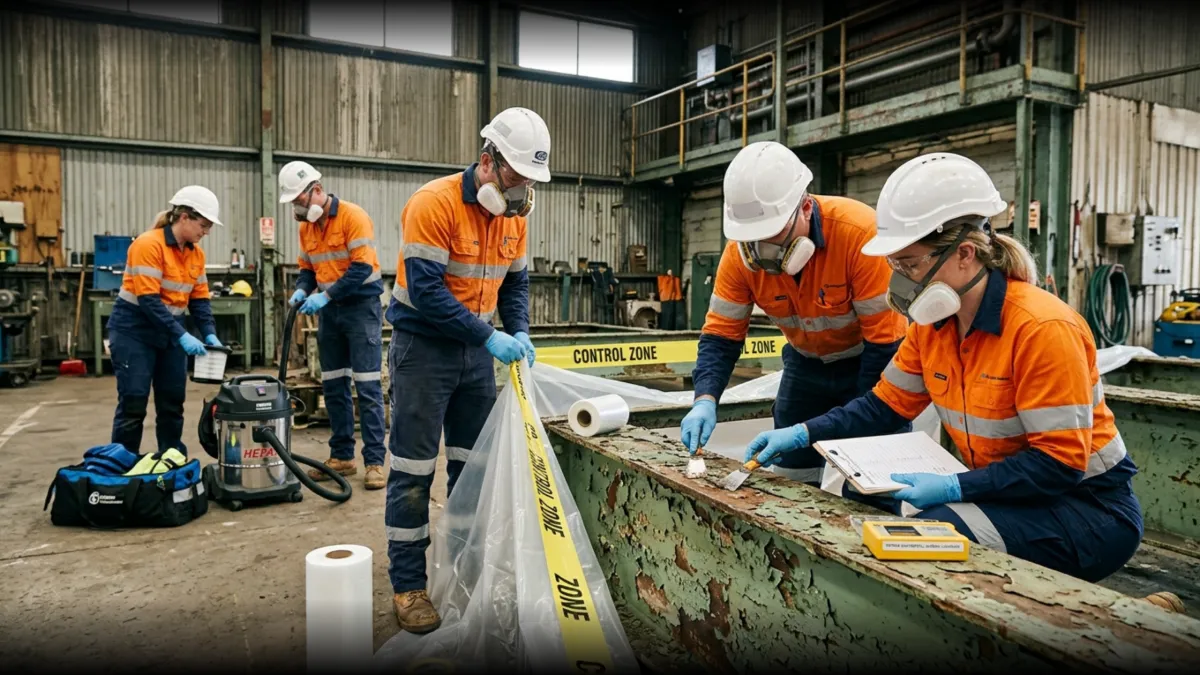
PPE has a role, but it should not be treated as the whole answer.
If lead dust or fumes are being generated, the business needs to think more broadly.
Can the material be tested before work begins?
Can the task be avoided or changed?
Can the work method reduce dust or fumes?
Can the area be isolated?
Can dust be contained?
Can ventilation or extraction be used?
Can contaminated waste be handled safely?
Can workers clean up without spreading the exposure?
Can other people be kept away from the work area?
A respirator does not fix poor planning.
Gloves do not stop dust spreading through a site.
A disposable suit does not replace proper containment, cleaning, and hygiene.
That does not mean PPE is unimportant. It means PPE needs to sit inside a stronger system.
Hygiene Is a Safety Control
Lead exposure is not only about what happens during the task.
It is also about what happens after.
Dust on hands, clothing, boots, tools, vehicles, and surfaces can keep creating exposure once the job looks finished.
Workers can eat, drink, smoke, or touch their face with contaminated hands.
Dust can be carried into lunchrooms, utes, offices, homes, or shared spaces.
Tools and equipment can be packed away without being cleaned properly.
Waste can be handled casually because it does not look dangerous.
That is why hygiene matters.
Hand washing, clean changing areas, controlled eating and drinking areas, proper decontamination, suitable cleaning methods, and safe waste handling are not minor details.
They are part of the control.
If the only focus is what happens while the tool is running, the business may miss how exposure continues after the task stops.
Health Monitoring Should Not Be an Afterthought
One of the reasons lead exposure needs careful management is that harm may not be immediate or obvious.
A worker may keep working.
They may feel tired, unwell, or not quite right, without connecting it to workplace exposure.
The business may not see a clear incident.
That makes health monitoring important where required.
Health monitoring should not be treated as an administrative burden or something to work out later.
If the work may expose workers to lead, the business needs to understand whether health monitoring obligations apply and how they will be managed properly.
That includes knowing who may be exposed, what tasks they perform, how often exposure may occur, and what controls are in place.
If that information is vague, the system is already weak.
This Is Not Just a Construction Issue
Construction is an obvious place to talk about lead because of older buildings, coatings, demolition, and refurbishment work.
But the same issue appears across many industries.
A farm workshop can create exposure during repairs or surface preparation.
A manufacturing workplace can create exposure through materials, components, or production processes.
A recycling business can create exposure through scrap handling or dust.
A small trade business can create exposure during repainting, cutting, grinding, or restoration work.
A maintenance team can create exposure when working on older plant, structures, or painted surfaces.
The industry changes.
The principle does not.
If the material, dust, fume, residue, or waste may contain lead, the risk needs to be identified and controlled before people are exposed.
What This Means For You
If your business carries out work that could disturb old coatings, metal, dust, residue, contaminated surfaces, or lead-containing materials, the key question is not:
“Do we usually work with lead?”
The better question is: “Could this task expose someone to lead?”
That shift matters.
Many businesses miss lead risks because they do not see themselves as a “lead workplace.”
But exposure does not care what category the business puts itself in.
It depends on the material, the task, the method, the controls, and the people nearby.
If your workers are cutting, sanding, blasting, demolishing, stripping, welding, cleaning, repairing, or handling materials where lead may be present, the risk needs to be considered.
Not after the job starts.
Before.
Practical Checks Before Work Starts
Before work begins, take time to check the basics properly.
Identify whether the material, coating, dust, residue, or waste could contain lead
Test or verify materials where lead may be present, especially in older buildings, plant, or structures
Plan controls before the work starts, not once dust or fumes are already being generated
Use work methods that reduce dust, fumes, spread, and contamination
Isolate or contain the work area where exposure could affect others
Make sure PPE is suitable, fitted, worn correctly, and supported by higher-order controls
Provide proper hygiene, decontamination, cleaning, and waste handling arrangements
Check whether health monitoring is required and make sure it is actually followed through
These steps are not complicated.
But they do require planning.
And planning is usually where the difference is made.
The Real Lesson
Lead exposure is not just an old paint problem.
It is not just a construction problem.
It is not just a big industry problem.
It is a workplace exposure risk that can appear anywhere the material, task, or environment creates the conditions for harm.
The danger is that it can look ordinary.
A bit of sanding.
A bit of cutting.
A quick repair.
A small demolition job.
A dusty clean-up.
A painted surface that no one tested.
That is where the risk can sit.
Not in the dramatic moment, but in the quiet assumption that the job is routine.
Safe Work Australia’s current consultation is a useful reminder to look again at how these risks are being managed.
But businesses do not need to wait for regulatory change to improve what they are doing now.
Get in touch with Synergy Safety Solutions for practical support reviewing how your business manages hazardous substance and workplace exposure risks.
If lead exposure could be part of your work, now is the time to check whether your systems are clear, practical, and actually being followed.