




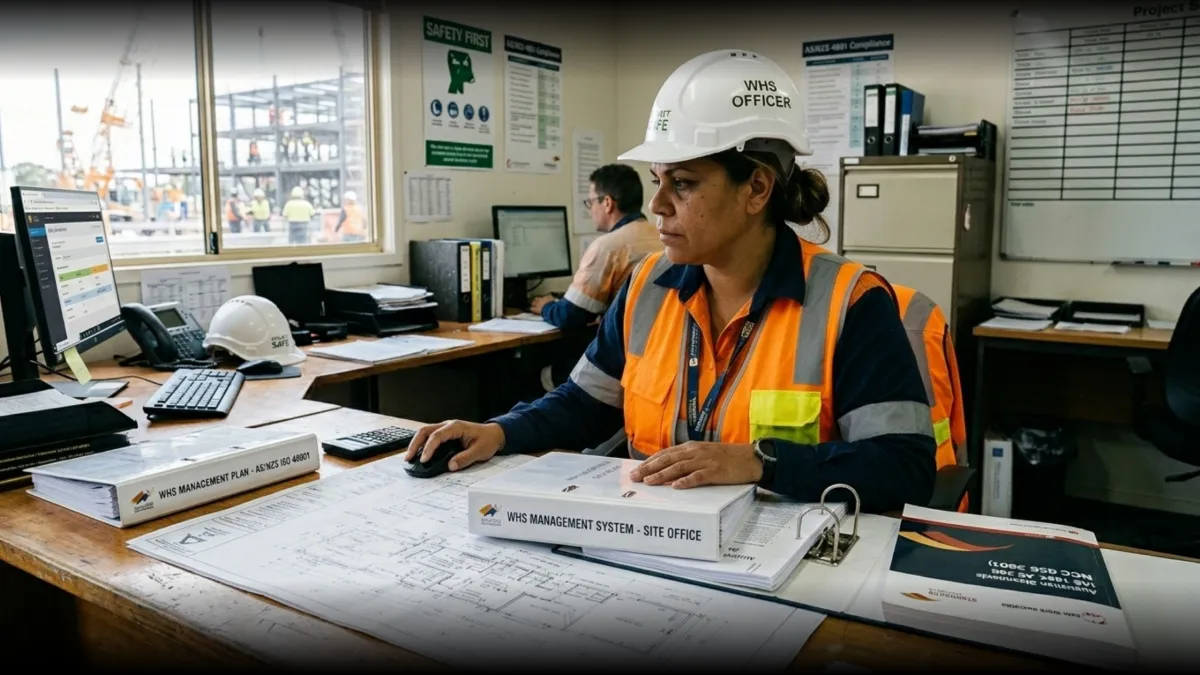
Free Access to Australian Standards: What It Actually Means for Construction
From July 2026, the Australian Government is moving to make mandatory Australian Standards freely accessible.
That includes standards across areas such as construction, occupational health and safety, and product safety.
For years, many businesses have had to pay significant fees just to access documents that are often referenced in legislation, Codes, contracts, specifications, and tenders.
On the surface, this sounds like a big win.
And in many ways, it is.
But like most things in safety, access to paperwork is only part of the story.
The real question is what businesses do with that access.
What Are Australian Standards?
Australian Standards are not Acts of Parliament.
They are not the same as WHS laws or Regulations.
But they often carry significant weight because they are referenced in legislation, Codes of Practice, contracts, specifications, and industry expectations.
In simple terms:
The law sets the duty
Regulations and Codes provide more detail
Standards often describe accepted technical or practical benchmarks
In construction, Standards can influence decisions around plant, design, scaffolding, fall prevention, electrical work, PPE, equipment, and safe systems of work.
That means they matter.
The problem has always been access.
Many small builders, subcontractors, and supervisors have never read the actual Standards relevant to their work because they sat behind expensive paywalls.
Free access starts to remove that barrier.
Why This Matters for Construction
Construction contracts regularly include wording like: “Work must comply with all relevant Australian Standards.”
That sentence can carry a lot of weight.
But if a business cannot easily access the Standard being referenced, compliance can become guesswork.
Free access may improve:
transparency in contracts and tenders
fairness for small businesses
understanding of technical requirements
ability to check supplier claims
confidence when reviewing safety systems
consistency across project planning and procurement
It also removes one of the common barriers: “We couldn’t access it.”
That changes the playing field.
If the benchmark is available, businesses have a better opportunity to understand what is being expected of them.
But they also carry more responsibility to engage with it properly.
Access Does Not Equal Understanding
This is the important part.
Making Standards easier to access does not automatically make worksites safer.
Documents don’t change behaviour by themselves.
Leadership does.
Systems do.
Supervision does.
Practical application does.
What we need to avoid is businesses thinking: “We’ll download a few Standards and we’re covered.”
That is not how safety works.
Standards are reference documents. They help inform design, procurement, planning, risk control, and decision-making.
They DO NOT replace:
risk assessments
SWMS
consultation
supervision
competent advice
site-specific judgement
They also need interpretation.
Many Standards are technical. They are not written like toolbox talks. They are not always easy for a busy supervisor or small business owner to translate into day-to-day action.
So yes, access is a good thing. But understanding and implementation are what matter.
That is the same principle we apply when using any safety information. Having access to an answer is not the same as applying judgement in the real world, a point also explored in AI Can’t Think for You: What That Means for Safety on Site.
The Compliance Trap
There is also another risk.
When businesses gain easier access to technical documents, some may become more focused on document alignment than actual risk control.
That can look like:
collecting Standards without reviewing how they apply
updating procedures without changing site practice
relying on supplier statements without checking suitability
quoting Standards in SWMS without understanding them
assuming “compliant product” means “safe system”
This is where compliance can become performative.
A Standard can help guide good decisions.
But it does not remove the need to ask: Does this actually control the risk in our work environment?
A site can look organised and still carry hidden gaps between paperwork and reality, which is something we explored in The Sites That Looked Safest Sometimes Worried Me the Most.
Construction-Specific Implications
For builders, contractors, and safety managers, this change may be useful in several practical areas.
1. Tender and contract review
You can check which Standards are being referenced before you price, sign, or commit.
That matters because a contract requirement can create obligations that affect cost, procurement, method, and risk control.
2. Procurement decisions
When buying or hiring equipment, systems, anchors, guardrails, scaffolding components, platforms, or PPE, you can better understand what “compliant” actually means.
This can help you ask better questions of suppliers.
3. Design and planning conversations
Project managers, engineers, builders, and subcontractors can refer to the same benchmark when making decisions.
That can reduce assumptions.
4. Procedure development
Safety managers and business owners can align procedures with recognised benchmarks where appropriate.
But procedures still need to reflect how work is actually done.
5. Due diligence and defensibility
Understanding relevant Standards can help demonstrate that your business has taken reasonable steps to understand known risks and accepted controls.
But the Standard is not the whole answer.
Your system still needs to work in practice.
The broader complexity of Australian construction safety requirements is something we have also unpacked in THE HIDDEN BLUEPRINT: 5 Surprising Truths About Australian Construction Safety.
What This Means For You
If you run a construction business, supervise teams, or manage WHS systems, this change is worth paying attention to.
It does not mean you need to suddenly become a Standards expert.
But it does mean you should know which Standards are relevant to your work.
You should also know where they appear in:
contracts
tenders
supplier documents
SWMS
procedures
design requirements
procurement specifications
Standards support WHS duties. They do not override them.
The primary duty remains the same: eliminate or minimise risk so far as reasonably practicable.
Free access gives businesses another tool.
Like any tool, it only helps if it is used properly.
Practical Action Checklist
Here’s how I’d suggest approaching this change.
Review which Australian Standards are referenced in your contracts, tenders, and procedures
Identify which Standards relate to high-risk activities in your business
Check whether supplier claims are specific or vague
Assign responsibility for reviewing relevant Standards, rather than assuming “someone else” has it covered
Align internal procedures with key benchmarks where appropriate
Use Standards to inform supervisor training, not overwhelm workers with technical detail
Check whether your SWMS and procedures reflect actual site practice
Keep the focus on practical risk control, not document collection
This does not need to become another paperwork exercise.
The goal is not to build a bigger folder.
The goal is to make better decisions.
The Bigger Issue
Free access removes a financial barrier.
It does not remove the need for competent leadership.
In construction, safety performance rarely improves because a document becomes available.
It improves because someone takes ownership of how that document applies to the work.
It improves when supervisors are supported.
It improves when builders stop treating technical safety knowledge as something to outsource entirely.
And it improves when systems are reviewed against real work, not just against what is written on paper.
That is where the real opportunity sits.
If you’d like help reviewing how Australian Standards intersect with your WHS systems, contracts, and site practices, get in touch with Synergy Safety Solutions for a practical conversation.