




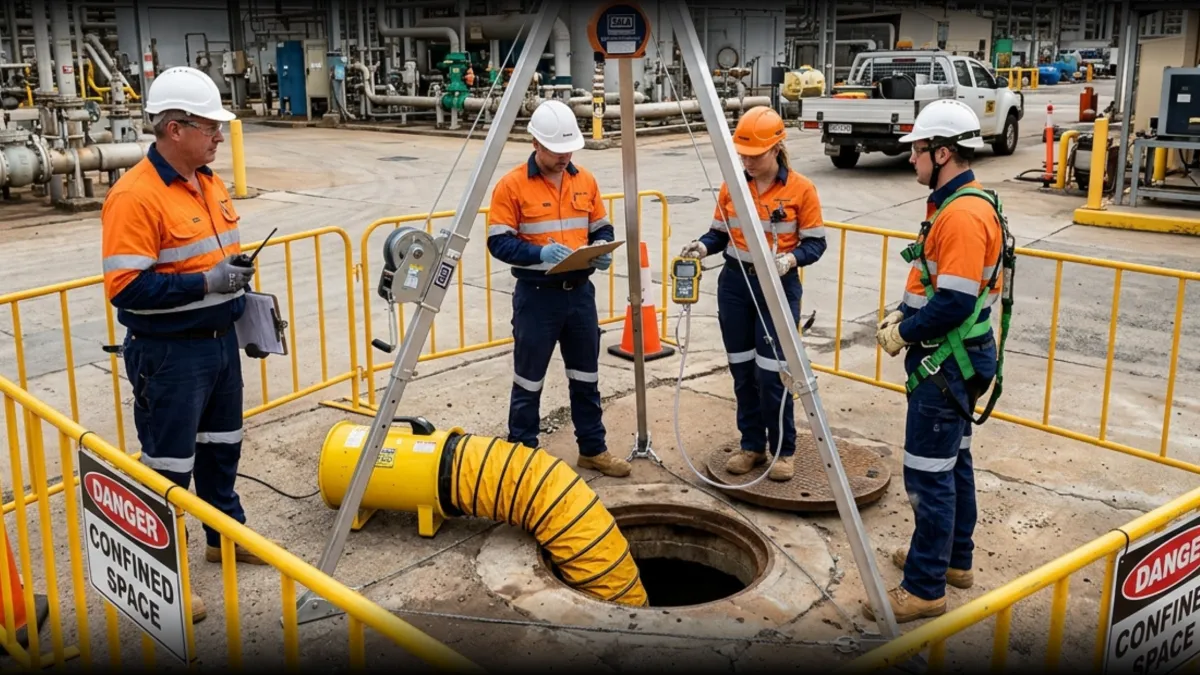
Confined Space Safety Needs More Than a Permit
Confined space work is not dangerous just because the space is small.
It is dangerous because a worker can enter a tank, pit, drain, silo, vessel, shaft, or service area and be exposed to hazards that are hard to see, hard to escape from, and quick to change.
The air might not be safe.
A substance could move or release.
Heat, fumes, dust, or vapour could build up.
Communication can become difficult.
Rescue can become complicated very quickly.
That is why a confined space permit matters.
But the permit is not what keeps someone safe.
The real protection comes from understanding the space, the task, the atmosphere, the access, the isolation, the people involved, and what could change once the work begins.
This is where confined space safety can go wrong.
A business may have a permit system. It may have gas testing. It may have a standby person. It may have a rescue plan written down.
But if the focus becomes “have we completed the permit?” instead of “are the hazards controlled right now?”, the system can start to fail.
Confined space safety needs more than a form.
It needs active risk management before entry, during the work, and whenever conditions change.
The Permit Is Not the Protection
A confined space permit is important.
It helps slow the job down enough to check the work, confirm controls, and make sure the right people understand what is happening.
But the permit itself does not make the space safe.
A signed permit does not remove a toxic atmosphere.
A completed checklist does not stop oxygen levels from changing.
A gas test at the start does not guarantee the air will stay safe halfway through the task.
A rescue plan written in a folder does not help if the people involved do not understand what they would actually do in an emergency.
The permit is a tool.
It is not the protection.
The protection comes from the thinking, planning, checking, monitoring, supervision, and willingness to stop when something changes.
That is the difference between managing the process and managing the hazard.
A Confined Space Is Not One Single Risk
It is easy to talk about “confined space risk” as if it is one thing.
It is not.
A confined space is an environment where several hazards can exist at once, and those hazards can change quickly.
Depending on the space and the task, workers may be dealing with:
low or high oxygen levels
toxic or flammable atmospheres
dusts, fumes, vapours, or airborne contaminants
stored energy from plant, pipes, valves, or systems
heat stress
restricted access and poor visibility
engulfment or entrapment risks
movement of machinery, materials, or liquids
difficulty communicating with people outside the space
That is why confined space work needs more than a standard approach.
A tank being cleaned is different from a pit being inspected.
A shaft being entered for maintenance is different from a vessel where hot work is being done.
A space that was safe at entry may not be safe later if the task introduces fumes, chemicals, heat, dust, or movement.
The space is not the only issue.
The task changes the risk.
The Risk Can Change While the Job Is Happening
This is one of the biggest traps in confined space work.
People can treat the risk assessment as something that happens before the job starts, then assume the conditions will stay the same.
But confined space work is not static.
Cleaning can introduce vapours.
Welding can change the atmosphere.
Grinding can create dust.
A pump can restart.
A valve can leak.
Heat can build.
Communication can break down.
A worker can become fatigued.
The task can take longer than planned.
None of these changes need to be dramatic to matter. They simply need to be enough to make the original controls less effective.
That is where incidents often begin.
Not with one obvious failure.
But with a slow drift between what the system said would happen and what is actually happening in the space.
This is why safety cannot rely on common sense or paperwork alone. As we explored in The Hidden Blueprint: 5 Surprising Truths About Australian Construction Safety, practical safety systems need to hold up in the real conditions of the work, not just in the version of the job written down before it starts.
When Controls Become a Checklist
Most workplaces are not ignoring confined space safety.
That is not usually the issue.
The issue is that the controls can become familiar.
The permit gets completed because that is the process.
The gas monitor is used because it is required.
The standby person is assigned because the procedure says so.
The ventilation is set up because that is what the team normally does.
None of that is wrong.
But if no one is actively asking whether those controls still match the hazards, the work can become too automatic.
That is when the checklist starts replacing the thinking.
You see it when people say things like:
“We always do it this way.”
“It was fine last time.”
“The permit is already approved.”
“We’ve done the gas test.”
“It should only take a few minutes.”
Those lines sound ordinary.
But in high-risk work, ordinary assumptions can become serious gaps.
Controls Have Limits
Controls matter, but every control has limits.
Ventilation only works if it suits the space, the contaminant, the task, and the airflow.
Gas testing only works if it is done correctly, at the right points, at the right frequency, and interpreted properly.
Isolation only works if every relevant source of energy has been identified and secured.
A standby person only works as a control if they understand the role, stay focused, and have a clear way to raise the alarm.
A rescue plan only works if it can actually be done with the people, equipment, and time available.
This is where confined space safety needs honest questions.
Not just, “Do we have the control?”
But, “Will this control actually work here?”
That is the question that changes the quality of the system.
This Is Not Just a Construction Issue
Confined space risk shows up across many industries.
In construction, it may involve pits, shafts, tanks, trenches, ducts, or service areas.
In manufacturing, it may involve vessels, hoppers, silos, pits, or process equipment.
In agriculture, it may involve tanks, silos, wells, feed systems, or enclosed storage areas.
In utilities and local government, it may involve drains, pipelines, manholes, pump stations, and service pits.
In mining and heavy industry, it may involve plant, shutdown work, maintenance areas, and enclosed infrastructure.
The industry changes.
The principle does not.
If people are entering a space where the atmosphere, access, layout, contents, energy sources, or emergency response could put them at risk, the work needs to be planned and controlled properly.
And it needs to be checked as the job changes.
Good Supervision Is Not Just Watching the Job
Confined space supervision is not just about having someone present.
It is about having someone who understands what can change and is prepared to act when it does.
Good supervision looks for the gap between the plan and the real work.
Has the job changed?
Is the work taking longer than expected?
Are workers communicating clearly?
Is the atmosphere still being monitored properly?
Has a new task introduced a new hazard?
Are people rushing because of time pressure?
Is anyone assuming the space is safe because it was safe earlier?
That kind of supervision is practical. It is not about hovering over people or slowing everything down for the sake of it.
It is about keeping the work connected to the actual risk.
A workplace can look organised on the surface while serious operational risks are still sitting underneath, which is something we unpacked further in The Sites That Looked Safest Sometimes Worried Me the Most.
Confined space work is one area where that surface-level confidence can be especially dangerous.
What This Means For You
If your business manages confined space work, the key question is not:
“Do we have a confined space process?”
You probably do.
The better question is:
“Does our process keep people focused on the hazards as the work changes?”
That is where the real test sits.
A confined space procedure should not just help people complete paperwork. It should help them understand the space, the task, the changing conditions, and the controls that need to stay effective from start to finish.
This matters for business owners, managers, supervisors, contractors, and workers.
Everyone involved needs to understand that confined space safety is not a one-time check before entry.
It is active risk management throughout the job.
Practical Checks Before and During Confined Space Work
Before confined space work begins, and while the work is underway, take time to check the basics properly.
Start with the hazards, not the permit
Confirm whether the space, task, atmosphere, access, and emergency arrangements have been properly assessed
Check whether conditions could change once the work begins
Make sure gas testing and monitoring match the actual task and space
Review whether ventilation, isolation, communication, lighting, and PPE are suitable for the work being done
Confirm the standby person understands their role and has a clear escalation process
Make sure the rescue plan is practical, not just written down
Reassess the work if the task, timing, conditions, equipment, or people change
These are not complicated ideas.
But they require attention.
And attention is exactly what gets lost when a high-risk task becomes routine.
The Real Lesson
Confined space safety does not fail only when a workplace has no system.
It can also fail when the system becomes too comfortable.
When the permit becomes the focus.
When the checklist becomes the measure of safety.
When the gas test is treated as a guarantee.
When the rescue plan exists, but no one has tested whether it would work.
When everyone assumes the job is controlled because the paperwork says it is.
That is why confined space safety needs more than a permit.
It needs people who understand the hazards.
It needs controls that match the task.
It needs supervisors who can see when conditions are changing.
It needs workers who feel able to stop and speak up.
And it needs leaders who care more about whether the system works than whether the form is complete.
If your confined space process looks good on paper, but you are not sure how well it holds up in real work conditions, now is the time to take a closer look.