




Who Coordinates Safety When Several Businesses Share the Work?
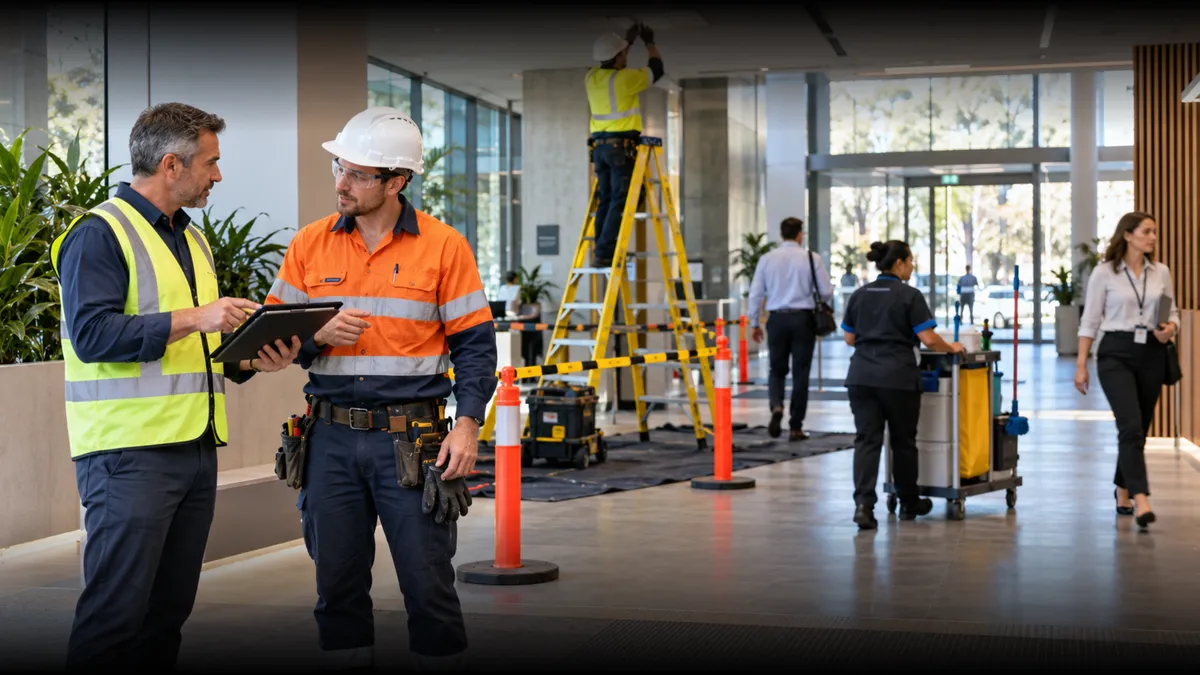
A maintenance contractor arrives at a commercial building to carry out planned repairs.
The cleaning team is finishing its shift.
Employees are moving through shared areas.
Another contractor is working nearby.
Each business has its own tasks, people and safety arrangements.
But has anyone checked how those activities affect one another?
This is where shared workplaces can become complicated. One business may be managing its own work properly while overlooking the risks created when that work interacts with someone else's.
The question is not simply who is responsible for each job. It is who is making sure the work can happen safely together.
Several Businesses Can Share the Same Safety Duty
When different businesses operate in the same workplace, their health and safety responsibilities can overlap.
This may involve a principal contractor and subcontractors on a construction project, a building owner and its tenants, or a host business and labour hire provider.
The businesses may have different roles, but each can have duties relating to the same workers, workplace conditions or activities.
Under the model Work Health and Safety Act, these businesses are often described as persons conducting a business or undertaking, or PCBUs.
Section 46 of the model WHS Act requires duty holders with responsibilities relating to the same matter to consult, cooperate and coordinate their activities, so far as is reasonably practicable.
A business cannot simply assume that another contractor has taken care of a shared safety responsibility.
Safe Work Australia explains that businesses sharing WHS duties need to exchange information, understand who is doing what, and work together to manage shared risks.
The model WHS framework has been implemented in most Australian jurisdictions, with variations. Victoria operates under its own occupational health and safety legislation. Businesses should check the requirements applying to their workplace.
Where Coordination Starts to Break Down
The problem is not always a lack of safety documents.
It can be the assumptions businesses make about what another team is doing.
Consider how ordinary work overlaps:
In warehouses, maintenance contractors may need access to machinery while normal operations continue. Who confirms the equipment has been isolated and can safely return to service?
In commercial buildings, cleaners and maintenance contractors may use the same areas. Has anyone checked whether one activity creates a hazard for the other?
On construction sites, changes to temporary access, deliveries or work sequencing can affect several trades at once.
The risks differ, but the underlying issue is familiar.
Does each business understand only its own work, or can everyone see how the activities affect one another?
Having a Lead Contractor Does Not Remove Everyone Else's Duties
It makes sense for one person or business to coordinate a shared activity.
A site manager might organise access. A principal contractor may coordinate construction activities. A facilities manager may oversee maintenance work in an occupied building.
But appointing someone to coordinate the work does not automatically remove the WHS duties held by others.
Under the model WHS framework, each duty holder retains responsibility to the extent they can influence or control the matter.
Safe Work Australia's model Code of Practice provides practical guidance on consulting, cooperating and coordinating where more than one business has WHS responsibilities. It helps clarify how businesses can make their arrangements work together.
A useful arrangement makes it clear:
Who controls the relevant workplace or equipment.
Who communicates changes to other businesses.
Who checks that agreed safety measures are in place.
Who has authority to pause work when arrangements are no longer suitable.
The aim is not to create another layer of paperwork. It is to make sure important decisions have been made and understood.
Coordination Needs to Begin Before Work Starts
Effective coordination starts during planning, not when several teams arrive and begin competing for the same space.
Businesses need to understand what work will take place, when it will happen and who could be affected.
This may involve agreeing on access arrangements, separating incompatible activities, arranging equipment isolation or scheduling work so one task does not create unnecessary exposure for another.
Consultation with affected workers and their health and safety representatives, where applicable, is also important. The people carrying out the work may identify interactions that are not obvious from the original plan.
Communication should be practical and appropriate to the work. A short discussion between two contractors may be enough for a straightforward activity, while more complex arrangements may require documented responsibilities, coordinated schedules and regular meetings.
The important part is whether everyone understands the arrangements and can work within them.
What Happens When the Work Changes?
Even well-planned work can change.
A contractor arrives late. Maintenance takes longer than expected. Another business needs access to an area earlier than planned.
A task that was safe when considered on its own may become more complicated when the surrounding activities change.
This is where ongoing coordination matters.
Who needs to be informed? Do access controls or work schedules need reviewing? Can the activity continue safely, or should it be paused until the arrangements are confirmed?
Where changes affect shared risks, the businesses involved need a practical way to communicate, reassess controls and confirm that work can continue safely.
What This Means For You
If your business engages contractors, uses labour hire, manages commercial premises or regularly works alongside other organisations, shared WHS responsibilities are worth reviewing.
Start by looking at where your business's activities overlap with someone else's.
You may have clearly defined responsibilities within your own team, but what happens at the point where another business becomes involved?
Are contractors aware of your workplace hazards?
Do your workers understand the contractor's activities?
Who manages shared access and communicates changes?
And when something does not go to plan, is there a clear person to contact and an agreed way to respond?
Having separate safety systems does not necessarily mean they work together.
Good coordination helps turn individual arrangements into controls that make sense across the shared workplace.
A Practical Shared Workplace Safety Check
Before multiple teams start work, review:
Who is involved: Identify the businesses, contractors, labour hire providers and others who may have overlapping WHS responsibilities.
Where the work interacts: Check shared access routes, equipment, work areas, schedules and activities that could affect other teams.
Who has been consulted: Confirm that affected workers, relevant representatives and other duty holders understand the planned work and risks.
Who manages each control: Agree who looks after access restrictions, equipment isolation, supervision and other shared safety arrangements.
How changes are communicated: Establish who must be informed when activities, schedules, personnel or workplace conditions change.
What happens if something goes wrong: Confirm escalation contacts, emergency arrangements and when work should be paused and reassessed.
Whether controls are working: Check that agreed arrangements are in place and review them when work or conditions change.
These questions are a starting point.
The level of coordination should reflect the work, the risks involved and the responsibilities of each business.
The Real Lesson
When several businesses share a workplace, safety cannot operate as a collection of disconnected arrangements.
One contractor's decisions may affect another team's access, equipment, timing or exposure to risk.
That is why coordination matters.
It brings the right people into the conversation, makes responsibilities clearer and helps businesses check that their controls work together.
The goal is not simply to know who owns each task. It is to make sure the gaps between those tasks are being managed.