




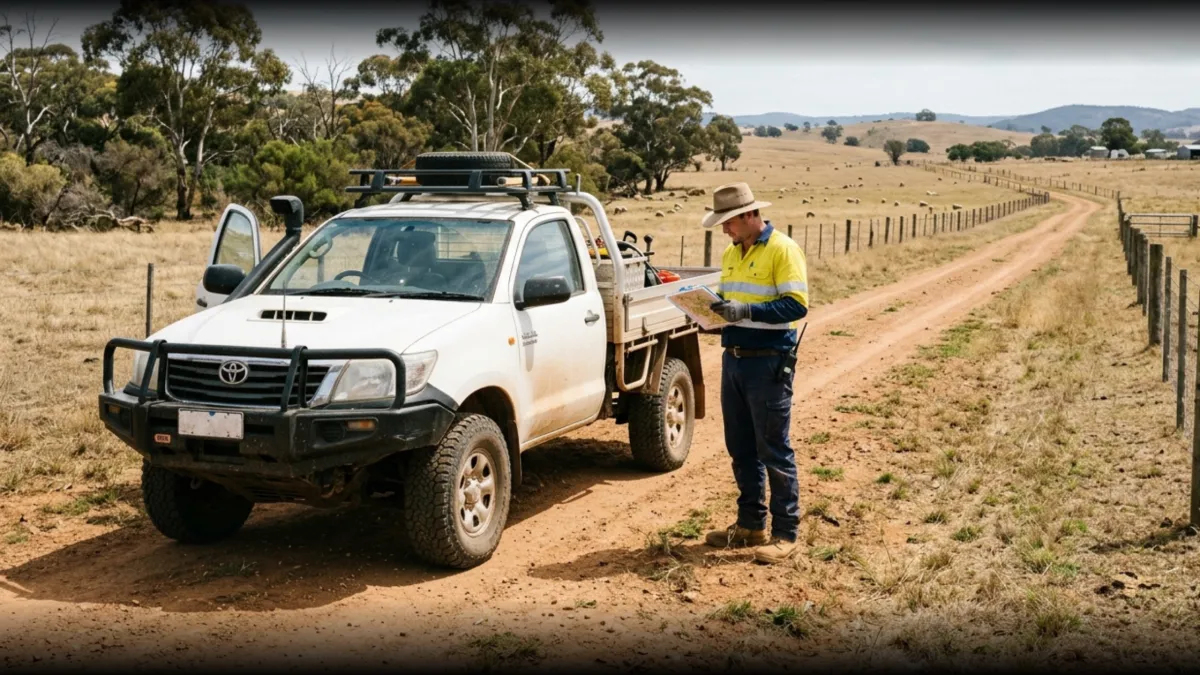
Rollover Risk Is Not Just a Driver Problem
When a vehicle rolls over, people often look first at the driver.
Were they going too fast?
Did they lose control?
Were they paying attention?
Those questions may matter, but they are not enough.
Because when driving is part of the job, a rollover is not just a road safety issue. It is a workplace safety issue.
And workplace safety has to look beyond the last few seconds before something went wrong.
It has to look at the system around the drive.
Was the right vehicle being used?
Was the road or terrain suitable?
Was the worker trained for the conditions?
Was the journey planned?
Was fatigue considered?
Was there a check-in process?
Was there a clear point where the worker could stop, delay, or change the task?
This is especially relevant during National Farm Safety Week (FarmSafe Australia), where the focus is on setting the standard for what becomes normal in day-to-day work.
On farms, in civil construction, in mining, in utilities, in community services, and in regional field work, driving is often treated as the ordinary part of the job.
But ordinary does not mean low-risk.
The Risk Starts Before the Vehicle Moves
A rollover may happen on the road, on a track, in a paddock, on a worksite, or between jobs.
But the risk often starts much earlier.
It starts when the job is planned.
It starts when a vehicle is chosen because it is available, not because it is suitable.
It starts when a worker is assumed to be capable because they hold a licence.
It starts when unsealed roads, rough ground, weather, fatigue, loads, time pressure, or isolation are treated as normal conditions instead of risk factors.
That is where many businesses get caught.
They know the work involves driving.
They know the roads are rough.
They know workers travel between sites, properties, communities, paddocks, or remote locations.
But they do not always turn that knowledge into clear controls.
A known risk that is not actively managed is still an unmanaged risk.
A Licence Is Not the Same as Competency
One of the biggest assumptions in workplace vehicle safety is that a driver’s licence equals work-ready competency.
It does not.
A standard licence does not automatically prepare someone to drive on loose gravel, corrugated roads, sand, mud, steep tracks, uneven ground, or remote roads where help may be delayed.
It does not mean they know how a loaded ute behaves differently from an empty one.
It does not mean they understand rollover risk, vehicle stability, tyre pressure, braking distances, water crossings, fatigue, or what to do when conditions change.
That does not mean workers are careless.
It means the task may require more than ordinary road experience.
If a worker is expected to drive as part of their job, the business needs to understand what kind of driving they are actually doing.
Metro driving is different from regional driving.
Sealed roads are different from unsealed roads.
A maintained access road is different from a paddock track.
Driving alone is different from travelling in a convoy.
A quick trip in good conditions is different from a long drive at the end of a hot day.
The training and supervision need to match the real exposure.
Rollover Risk Is a System Issue
It is easy to reduce a rollover to a single moment.
The vehicle turned.
The wheels lost traction.
The driver overcorrected.
The surface changed.
But work does not happen in isolated moments.
It happens inside a system.
For workplace vehicle use, that system includes:
vehicle selection
maintenance
load limits
road and terrain assessment
driver training
journey planning
fatigue management
weather decisions
communication
supervision
emergency response
If any of those parts are weak, the worker is left to manage too much risk in the moment.
That is not fair, and it is not reliable.
A safe system does not mean wrapping every drive in unnecessary paperwork.
It means making sure the practical decisions are clear before someone picks up the keys.
Who is allowed to drive in these conditions?
What vehicle should be used?
What route is suitable?
What weather or road conditions would stop the trip?
How often should the worker check in?
What happens if they do not arrive?
What support is available if something goes wrong?
Those are not complicated questions.
But they need to be answered before the trip, not after an incident.
This Is Not Just a Farm Issue
National Farm Safety Week (FarmSafe Australia) gives us a timely reason to talk about rollover risk, but this is not only an agriculture issue.
In construction, workers may drive utes across uneven sites, temporary access roads, subdivisions, civil works, or regional projects.
In agriculture, workers may travel between paddocks, properties, sheds, yards, and remote work areas on rough or changing terrain.
In mining and resources, workers may drive long distances in remote areas, often with fatigue, dust, wildlife, weather, and isolation as added factors.
In utilities and local government, workers may drive to service pits, pump stations, roadside assets, powerline corridors, or water infrastructure.
In community services, workers may travel long distances to support clients in regional or remote areas.
Different industries.
Same principle.
If driving is part of the work, then driving risk needs to be managed as part of the work.
“We’ve Always Done It This Way” Is Not a Control
Some of the biggest risks in vehicle safety come from normalised habits.
Everyone uses that road.
Everyone knows that track is rough.
Everyone drives that ute.
Everyone knows to slow down near the bend.
Everyone knows mobile reception drops out there.
Everyone knows the weather can change quickly.
The problem is that “everyone knows” is not the same as control.
It relies on memory, experience, judgement, and luck all lining up at the same time.
That might hold together for a while.
Until a new worker starts.
Until someone is tired.
Until a job runs late.
Until a load changes how the vehicle handles.
Until the road surface deteriorates.
Until the weather shifts.
Until the person driving is under pressure to get there.
This is how unsafe habits become normal, which we explored in When Unsafe Becomes Normal: The Cultural Barrier Construction Can’t Ignore.
Vehicle safety is one of those areas where normalisation can happen quietly because the task feels so familiar.
Remote Work Raises the Stakes
The further a worker is from immediate help, the more serious a vehicle incident can become.
That does not only apply to remote communities.
It can apply to regional properties, mine access roads, civil sites, roadside works, utility corridors, farms, and field service jobs.
A rollover in a city street and a rollover on a remote unsealed road are not the same situation.
Response times may be longer.
Communication may be limited.
Other vehicles may not pass for some time.
Weather and heat may make the situation worse.
A worker may be injured, trapped, disoriented, or unable to call for help.
That is why journey management and check-in processes matter.
They are not admin for the sake of admin.
They are part of the response system.
As we discussed in Lone Worker Safety Is Only as Good as the Response Behind It, an alert, check-in, or communication process only works if someone knows what to do next.
For vehicle travel, that means the business needs to know where workers are expected to be, when they should arrive, how they will check in, and what happens if they do not.
What This Means For You
If your workers drive as part of their job, especially on unsealed roads, rough ground, rural properties, remote areas, or changing worksites, rollover risk should not be treated as a driver-only issue.
The better question is not: “Are our workers careful drivers?”
The better question is: “Have we set up the work so they are not left managing the risk alone?”
That is where leadership matters.
It means checking whether your systems match the real conditions your people face.
It means not assuming that a licence, experience, or common sense will cover every situation.
It means setting clear expectations before the work starts.
It means giving workers permission to stop, delay, or change the plan when conditions are not right.
And it means making vehicle safety part of normal work planning, not something that only gets reviewed after an incident.
Practical Checks for Workplace Vehicle Use
If driving is part of your work, take time to review the basics.
Identify where workers drive, including unsealed roads, tracks, paddocks, remote areas, and temporary access routes
Match vehicles to the task, terrain, load, and conditions
Check whether workers need four-wheel-drive, off-road, or terrain-specific training
Confirm competency, not just licence status or course attendance
Set clear expectations around speed, loads, fatigue, weather, road conditions, and stopping work
Use journey management or check-in processes where travel is remote, isolated, or higher risk
Make sure vehicles are maintained and suitable for the environments they are used in
Give workers clear authority to stop or delay travel if conditions change
These checks are practical.
They are not about blaming drivers.
They are about making sure the work is set up properly before people are exposed to the risk.
The Real Lesson
Rollover risk does not begin at the moment a vehicle tips.
It begins in the decisions that happen before the drive starts.
The job planning.
The vehicle choice.
The assumptions about driver competency.
The road conditions.
The fatigue.
The check-in process.
The leadership standard.
If those things are left informal, the worker carries the gap.
That is not good enough.
Driving for work can feel ordinary because it happens every day.
But when a vehicle is being used for work, especially in regional, rural, remote, or uneven environments, it needs the same level of practical risk management as any other work activity.
Rollover risk is not just a driver problem.
It is a work system issue.
If your team drives for work and you are not sure whether your current systems properly manage the risk.