




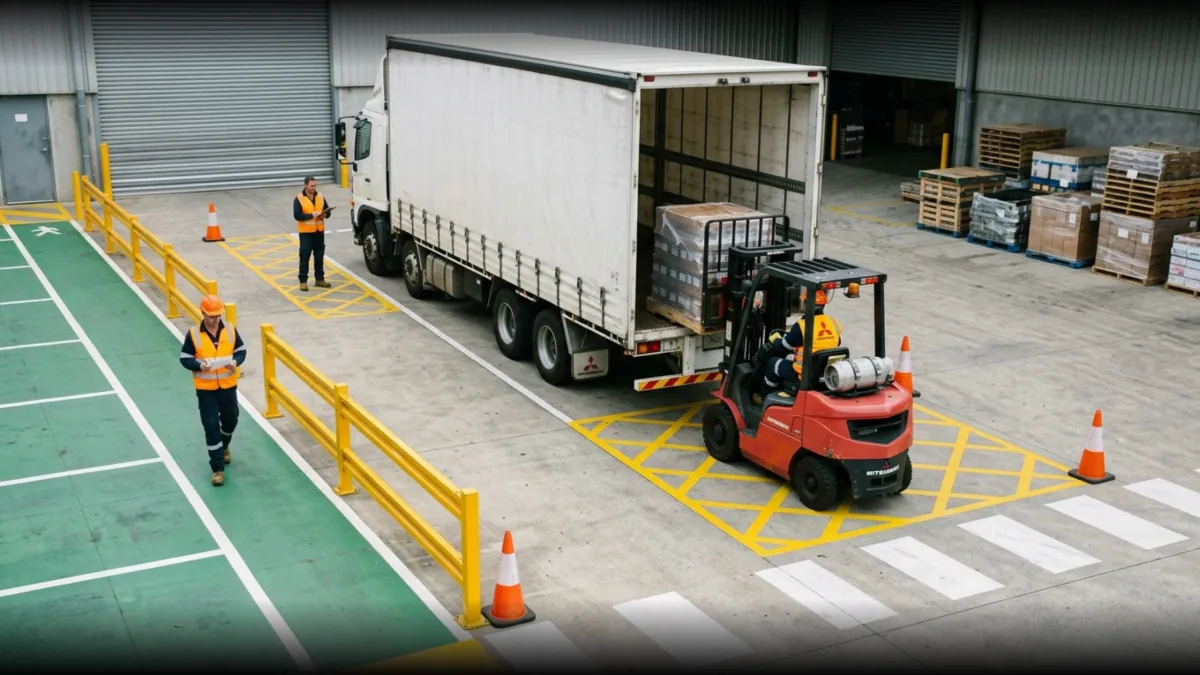
Loading Areas Need More Than a Traffic Management Plan
Loading areas can look ordinary.
A truck arrives.
A forklift starts moving.
A driver waits nearby.
Workers keep doing their job.
Materials need to be loaded, unloaded, moved, stored, checked or signed off.
Nothing about that may feel unusual.
That is part of the risk.
Loading areas are often treated as working spaces where people and mobile plant are expected to move around each other. Everyone assumes the other person knows where to stand, where to walk, when to wait and who has right of way.
But assumptions are not traffic controls.
A recent WorkSafe Victoria matter shows why this risk deserves attention. WorkSafe reported that a truck driver was struck by a forklift while waiting for his truck to be packed in a loading area at a Breakwater facility. The matter resulted in an enforceable undertaking that included an estimated $150,000 safety spend. WorkSafe also alleged the company failed to reduce the risk by not having a traffic management plan in place to protect people in the loading area, including truck drivers and forklift operators.
The detail that matters here is not only the forklift.
It is the shared space.
When forklifts, trucks, delivery drivers, workers, contractors and pedestrians are all moving through the same area, the risk is not controlled by hoping everyone sees each other in time.
It needs a system that reflects how the work actually happens.
A Traffic Management Plan Is Not Just a Document
A traffic management plan matters.
It should help people understand how vehicles, mobile plant and pedestrians move through the workplace. It should set out routes, exclusion zones, parking areas, loading areas, pedestrian walkways, communication methods and responsibilities.
But the plan only works if it matches the real workplace.
A traffic management plan that sits in a folder will not protect a delivery driver standing in the wrong place.
A painted walkway will not help if materials are stored across it.
A sign will not fix a blind corner.
A procedure will not control the risk if contractors and visitors do not understand it.
The document is only useful when it shapes what people actually do.
That means the plan has to be visible, practical, communicated and reviewed when the work changes.
Loading Areas Are High-Interaction Zones
Loading areas deserve particular attention because they bring different people and priorities together.
Truck drivers may be focused on positioning their vehicle, waiting for loading, checking paperwork or staying close enough to communicate with site staff.
Forklift operators may be focused on load movement, visibility, time pressure, vehicle access and storage locations.
Workers may be walking through the area because it is the quickest path.
Contractors or visitors may not know the site layout.
Supervisors may assume the process is understood because it happens every day.
This is where normal work can become high-risk.
The issue is not always speed or careless behaviour. Often, the issue is that the workplace design allows too many movements to overlap.
If drivers have to stand near forklifts, that is a design problem.
If pedestrians need to cross active forklift routes, that is a design problem.
If loading areas change depending on how busy the site is, that needs to be controlled.
If contractors are expected to work it out when they arrive, the system is leaving too much to chance.
Separation Should Come Before Reliance on Attention
Forklift and pedestrian interaction is one of those risks where attention alone is not enough.
People can be distracted.
Loads can block visibility.
Forklifts can move in tight spaces.
Background noise can make communication harder.
Drivers and visitors may not know where the safest waiting area is.
Forklift operators may have limited visibility when reversing, turning or carrying a load.
That is why physical separation is so important.
Where reasonably practicable, workplaces should look for ways to keep people and mobile plant apart.
That might include:
defined pedestrian walkways
physical barriers or bollards
dedicated driver safety zones
controlled loading and unloading areas
exclusion zones around active forklift work
one-way traffic flow
separate entry and exit routes
marked crossings where pedestrians must cross a vehicle path
lighting and mirrors where visibility is limited
clear rules for when drivers can leave the cab or move through the area
Painted lines and signs can support the system, but they should not be the only control where the risk is serious.
A line on the ground can fade, be ignored, or be covered by pallets, product, vehicles or equipment.
A physical barrier is harder to misunderstand.
Driver Safety Zones Need to Be Clear
One practical question every loading area should answer is simple:
Where does the driver wait?
If the answer depends on habit, verbal instruction or whatever feels convenient on the day, the system is weak.
Truck drivers should not have to guess where to stand while loading or unloading happens. They should not be left waiting in a spot where forklifts are turning, reversing or travelling with loads.
A driver safety zone should be clearly identified, accessible and understood by the people using the area.
It also needs to connect with the actual loading process.
Who tells the driver where to go?
When can the driver leave the cab?
Can the driver enter the loading area at all?
How does the driver communicate with the forklift operator or supervisor?
What happens if the normal waiting area is blocked?
What happens if there are multiple trucks waiting?
These questions are practical, not theoretical.
They decide whether people are protected during the moments where the risk is highest.
Contractors and Visitors Need More Than a General Induction
Employees may understand the traffic arrangements because they work with them every day.
Contractors, delivery drivers and visitors often do not.
That matters because traffic management can fail when people outside the normal workforce enter the system.
A delivery driver may only visit once.
A contractor may arrive outside normal hours.
A visitor may follow the most obvious path, not the safest one.
A labour hire worker may know forklift safety generally, but not the specific layout of this workplace.
A general induction is not always enough.
People need clear, usable instructions for the area they are entering.
That includes where to park, where to walk, where not to stand, who to report to, which areas are restricted, and what to do if they are unsure.
This is not about overloading people with information.
It is about giving them the information that will stop them from walking into a moving plant area without realising it.
Forklift Safety Is Not Just About the Operator
Forklift operators need to be trained and competent.
That part matters.
But forklift safety is not only an operator issue.
The best operator is still working inside a system shaped by layout, workload, storage, scheduling, visibility, supervision and traffic flow.
If the loading area is crowded, rushed or poorly marked, the operator is being asked to manage too much risk in the moment.
If pedestrians can walk through an active forklift area, the operator is being asked to compensate for poor separation.
If delivery drivers do not know where to wait, the operator is working around uncertainty.
We made a similar point in A Training Card Is Not the Same as Site-Ready Competency. Training and competency matter, but they do not replace planning, supervision and practical controls around the work.
The same principle applies to forklift traffic management.
A licence or training record does not fix a loading area where people and plant are forced to share space unnecessarily.
Technology Can Help, But It Should Not Be the First Answer
Cameras, sensors, alarms, boom gates, proximity systems and other technology can play a useful role in traffic management.
They may help improve visibility, manage access, alert people to movement or reduce the chance of a person entering a high-risk area.
But technology should support a good traffic system, not hide the absence of one.
A camera does not physically separate a person from a forklift.
An alarm does not guarantee someone will hear it, understand it or respond in time.
A sensor does not remove the need for clear routes, controlled loading areas and safe waiting zones.
Good traffic management starts with the design of the workplace and the movement of people and vehicles.
Technology may strengthen that system.
It should not become a substitute for it.
This Is Not Just a Warehouse Issue
Loading area risk is not limited to warehouses.
It can appear anywhere trucks, forklifts, mobile plant, workers, contractors or visitors share space.
In manufacturing, it may involve loading docks, dispatch areas, storage yards and production deliveries.
In construction and civil work, it may involve delivery zones, temporary laydown areas, site access roads and mobile plant movement.
In agriculture, it may involve sheds, packing areas, yards, silos, chemical storage areas and produce loading.
In mining and resources, it may involve workshops, stores, maintenance yards and logistics areas.
In retail distribution and transport, it may involve depots, loading bays, reversing areas and high-turnover delivery zones.
In small businesses, it may be a shared driveway, workshop yard or back-of-house area where the system has never been formally reviewed.
Different industries.
Same risk pattern.
When people and vehicles share space, the workplace needs clear controls.
What This Means For You
If your workplace has a loading area, do not start by asking whether a traffic management plan exists.
Start by watching the work.
Where do trucks arrive?
Where do drivers wait?
Where do forklifts travel?
Where do pedestrians walk?
Where do contractors enter?
Where does visibility break down?
Where does the plan rely on people remembering what to do?
Where does the layout push people into the same space as moving plant?
That is where the useful information sits.
A traffic management plan should reflect the real movements in the workplace, not just the version of the site shown on a diagram.
If the plan does not match what people actually do, it needs to be reviewed.
Practical Checks for Loading Area Safety
If your workplace has trucks, forklifts or mobile plant moving near people, review the basics.
Identify where forklifts, trucks, pedestrians, contractors and visitors interact
Separate people and mobile plant wherever reasonably practicable
Create clear driver safety zones for loading and unloading activities
Make pedestrian routes obvious, protected and practical to use
Use exclusion zones around active forklift and loading areas
Review visibility, lighting, reversing movements, blind spots and turning areas
Make sure contractors, delivery drivers and visitors understand the traffic arrangements
Keep loading areas clear of stored materials that block walkways, routes or sightlines
Review the plan when work changes, traffic increases, layouts shift or incidents occur
These checks are not about adding paperwork for its own sake.
They are about designing movement so that safe behaviour is the easiest option.
The Real Lesson
Loading areas can feel routine because they are used every day.
That is exactly why they need attention.
The more familiar the movement becomes, the easier it is to stop seeing the risk.
A truck waiting to be loaded.
A forklift moving through the same space.
A driver standing nearby.
A pedestrian taking the quickest route.
A contractor trying to find the right person.
These moments can look ordinary until something goes wrong.
A traffic management plan should not simply prove that the workplace has a document.
It should help prevent people and mobile plant from being placed in the same danger zone.
If your loading area relies too heavily on people seeing each other, remembering informal rules or working around unclear traffic flow, now is the time to review it.