


Back Pain at Work Is Not Just a Personal Health Problem
Back pain at work is often treated like a personal issue.
Someone lifted something awkwardly.
Someone has a bad back.
Someone needs to stretch more, rest more, strengthen more, or manage their body better.
Sometimes those things may be part of the picture.
But they are not the whole picture.
When back pain, strain injuries, and musculoskeletal issues keep showing up in a workplace, it is worth looking beyond the individual worker and asking a more practical question:
What is the work doing to people’s bodies?
That question matters during Tradies National Health Month, but it also matters well beyond the trades.
Back pain and musculoskeletal harm can show up in construction, civil work, manufacturing, warehousing, transport, agriculture, workshops, offices, and small businesses.
The tasks may look different.
The pattern is often the same.
Repeated strain, awkward positions, poor access, time pressure, fatigue, unsuitable tools, and work that does not give the body enough recovery.
That is not just a health issue.
It is a work design issue.
It Is Not Only About Heavy Lifting
When people talk about back injuries at work, the conversation often goes straight to lifting.
How heavy was the object?
Did the worker bend their knees?
Did they twist?
Were they trained in manual handling?
Those questions can matter, but they are too narrow on their own.
Musculoskeletal risk is not only created by one heavy lift.
It can build through:
repeated movements
awkward postures
long periods of sitting, standing, kneeling, reaching, or bending
vibration from vehicles, plant, or tools
poor access to the work area
tools or materials stored at the wrong height
rushing because the job is behind
not enough task variation or recovery time
A worker might not be hurt by one task.
They may be affected by the way the task is repeated across a day, a week, or years of work.
That is why back pain at work can be easy to dismiss early.
It does not always start with an obvious incident.
It often starts as discomfort.
A tight back.
A sore shoulder.
A worker stretching more often.
Someone avoiding a task they used to do easily.
A crew informally swapping jobs because one person is struggling.
Those signs are easy to miss if the workplace only reacts when someone is already injured.
“That’s Just Part of the Job” Is a Risky Mindset
In physical industries, discomfort can become normalised.
People expect to be sore. They expect to push through.
They may not report early pain because they do not want to look weak, slow the job down, or create extra paperwork.
In some workplaces, that silence is seen as resilience.
But from a WHS perspective, silence can hide risk.
If workers are regularly finishing the day sore, struggling through certain tasks, or modifying how they work to avoid pain, that is information the business needs to know.
Not so someone can be blamed.
So the work can be reviewed.
If the same task keeps causing strain, the answer is not just another reminder to “use correct manual handling technique.”
The better question is:
Can the work be changed?
Can the load be reduced?
Can mechanical assistance be used?
Can materials be delivered closer to where they are needed?
Can work heights be adjusted?
Can the task be shared, rotated, redesigned, or planned differently?
Good safety management does not wait until the injury is formal.
It pays attention to the early signs.
Training Alone Will Not Fix Poor Work Design
Manual handling training has a place.
Workers need to understand risk, use equipment properly, and know how to raise concerns.
But training is not enough if the work itself keeps putting people in poor positions.
A worker can be trained and still be required to lift from ground level all day.
A supervisor can give good instructions and still have materials delivered to the wrong spot.
A team can know the right technique and still be rushed into awkward, repetitive work because the schedule is too tight.
That is why musculoskeletal risk needs to be managed through the work system, not just worker behaviour.
The design of the task matters.
The layout matters.
The timing matters.
The equipment matters.
The staffing matters.
The recovery time matters.
The culture around speaking up matters.
If those things are not reviewed, the same injuries keep coming back with different names attached.
This Is Not Just a Tradie Issue
Tradies National Health Month gives a timely reason to talk about this, but the issue is broader than trades.
In construction, it may show up through lifting, carrying, awkward access, overhead work, kneeling, bending, or using vibrating tools.
In agriculture, it may show up through lifting feed, handling animals, repairing machinery, driving across rough ground, or working long days in physically demanding conditions.
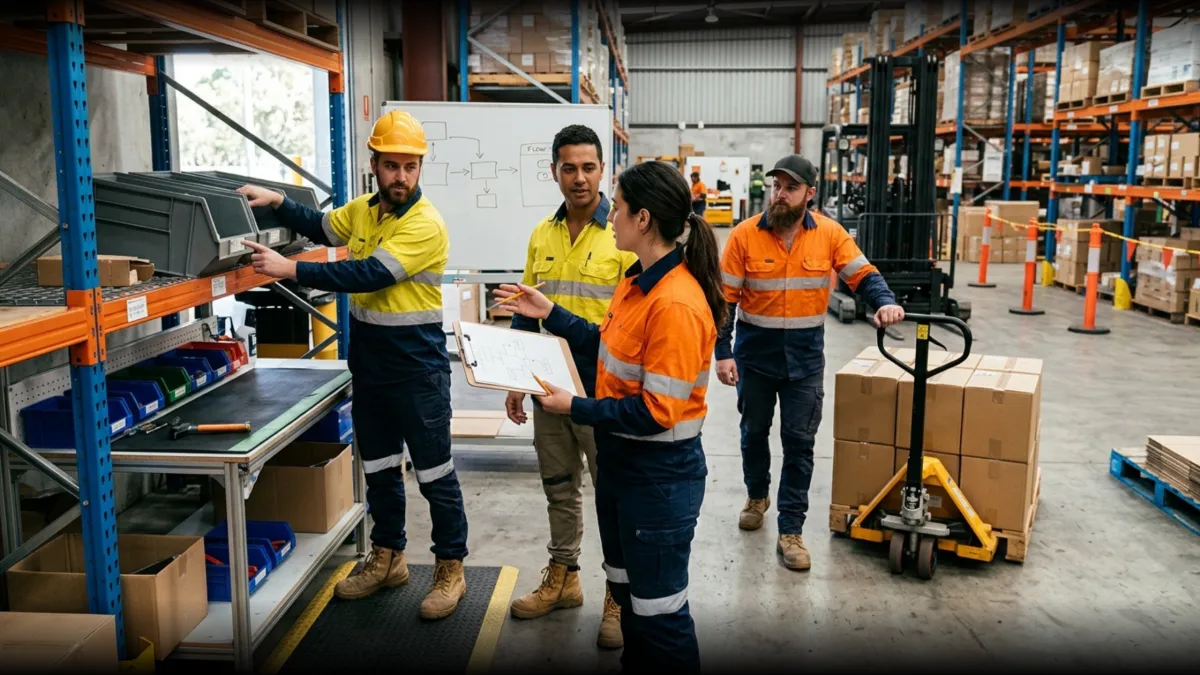
In manufacturing and warehousing, it may show up through repetition, standing work, packing, palletising, reaching, or poorly positioned workstations.
In transport and logistics, it may show up through long periods of driving, loading and unloading, vibration, fatigue, and rushed delivery schedules.
In offices, it may show up through prolonged sitting, poor workstation setup, low movement, stress, and long hours at a screen.
Different environments.
Same principle.
If the work places repeated or sustained strain on the body, the risk needs to be managed.
Pain Is Not Always Just Physical
One reason back pain and musculoskeletal issues are difficult to manage is that they are not always purely mechanical.
Physical strain matters.
But so do fatigue, stress, workload, job pressure, recovery, confidence, and whether people feel safe to speak up early.
When workers are under pressure, they may keep going even when their body is telling them something is wrong.
When deadlines are tight, small adjustments get skipped.
When staffing is thin, task rotation may disappear.
When workers think pain will be dismissed, they stay quiet.
When someone is already injured, stress and uncertainty can make recovery harder.
This does not mean every physical injury is caused by stress.
It means physical and psychosocial factors often sit together in the real world.
Good WHS management needs to look at both.
What This Means For You
If back pain or strain injuries are showing up in your workplace, the key question is not:
“Are our workers lifting properly?”
That is too small.
The better question is:
“What parts of the work are repeatedly placing strain on people’s bodies?”
That shifts the focus from blaming the person to improving the system.
Look at the work as it is actually done.
Not just the procedure.
Not just the training record.
Not just the assumption that people should know how to move safely.
Watch the task.
Talk to workers.
Look at the layout, the tools, the access, the pace, the repetition, the fatigue, and the moments where people quietly work around discomfort.
That is where useful information sits.
Practical Checks to Reduce Musculoskeletal Risk
If you want to reduce back pain and musculoskeletal injuries, start with the work.
Identify tasks that involve lifting, pushing, pulling, carrying, twisting, reaching, kneeling, vibration, repetition, or sustained posture
Watch how the task is actually done, not only how it is written in a procedure
Check whether materials, tools, and equipment are positioned at practical working heights
Reduce unnecessary handling by improving delivery, storage, access, and workflow
Use mechanical aids where they are practical and make sure they are available when needed
Rotate or redesign tasks where workers are exposed to the same movement or posture for long periods
Encourage early reporting of discomfort before it becomes an injury
Train supervisors to recognise early signs of strain and respond practically
Consider fatigue, workload, staffing, time pressure, and recovery as part of the risk picture
These steps do not need to be complicated.
But they need to be consistent.
And they need to be based on the real work, not assumptions about how the work should happen.
The Real Lesson
Back pain at work is not just a personal health problem.
It is often a sign that the work needs attention.
The task may need to change.
The tools may need to change.
The access may need to change.
The schedule may need to change.
The way discomfort is reported and managed may need to change.
A worker’s body should not be treated as the control that absorbs poor planning.
If the same type of pain keeps showing up, that is not random.
It is information.
And good businesses use that information to improve the work before someone is seriously injured.
Tradies National Health Month is a useful reminder, but this should not be a once-a-year conversation.
Musculoskeletal risk sits inside everyday work.
That means it needs everyday attention.
If your business is seeing back pain, strain injuries, or manual handling issues, get in touch with Synergy Safety Solutions for practical support reviewing how the work is being planned, designed, and managed.
If your business is seeing back pain, strain injuries, or manual handling issues, get in touch with Synergy Safety Solutions for practical support reviewing how the work is being planned, designed, and managed.